

You see the low-rise jean trend returning. You feel unsure if you can wear this style. You need to understand what "low-cut" really means before you try it.
Low-cut jeans, or low-rise jeans1, are a style where the waistband sits very low on the hips, far below your belly button. This cut was a defining look of the early 2000s and creates a silhouette that highlights the torso.

I have watched jean trends2 come and go for over 20 years. The rise and fall of different cuts is a cycle. The low-rise trend was one of the most dramatic styles I have seen in my career. At my denim factory, DiZNEW, we are starting to get requests for this cut again from designers like Dean. It is a very specific fit with its own history. I will explain exactly what it is.
What does "low-cut jeans" mean?
You hear stylists use terms like "low-cut" or "low-rise." You do not know the exact measurement. This makes it very hard to find the right pair online.
"Low-cut" refers to the "rise" of the jeans. The rise is the distance from the crotch seam to the top of the waistband. Low-cut jeans typically have a front rise of 8 inches or less, making them sit on your hips.
The rise measurement3 is everything. It determines where the jeans sit on your body. In the early 2000s, my factory produced jeans for premium brands with extremely low rises.
Some had a rise of only 7.25 or 7.5 inches. Today's "low-rise" is often not as low as the original Y2K styles. A modern low-rise might be 8.25 inches. This seems like a small difference, but it completely changes the fit. True vintage low-rise jeans1 from that era are much more extreme. We use precise measurements to define each type of rise for our clients.
Jean Rise Measurements
| Rise Type | Typical Measurement (Front Rise) | Where It Sits |
|---|---|---|
| Low-Rise | Under 8 inches | On the hips, below the navel |
| Mid-Rise | 8 to 9 inches | Just below the navel |
| High-Rise | Over 9 inches | At or above the navel |
These measurements are a general guide. The exact fit depends on your body and the brand's specific pattern.
What is the difference between low and high cut jeans?
You see jeans labeled as low, mid, and high-rise. You do not understand how they change your look. You cannot decide which style is best for your body type.
The main difference is where the waistband sits. Low-cut jeans sit on the hips. High-cut jeans sit at or above the natural waist. This single difference changes your entire body silhouette and the tops you can wear.

The pattern for a high-rise jean is very different from a low-rise one. In my factory, we have to completely change the curve of the hip and the shape of the seat for each style. A high-rise jean creates a longer leg line and defines the waist. It provides more coverage.
A low-rise jean puts the focus on your hips and torso. It was designed to be worn with crop tops. Neither style is better than the other. They just create different effects. Designers choose a rise based on the story they want to tell with their collection.
Fit and Silhouette Comparison
| Feature | Low-Cut Jeans | High-Cut Jeans |
|---|---|---|
| Waistband | Sits on the hips | Sits at the natural waist |
| Effect | Elongates the torso | Elongates the legs |
| Styling | Pairs well with crop tops | Pairs well with tucked-in shirts |
| Coverage | Minimal midsection coverage | Full midsection coverage |
A mid-rise jean is the most common style today. It offers a balance between the two extremes. It usually sits just below the belly button.
What is another name for low-cut jeans?
You search for "low-cut jeans" online. You see other terms like "hip-huggers." This is confusing. You want to know the correct words to use when shopping.
The most common name for low-cut jeans is "low-rise jeans." You will also hear older terms like "hip-huggers" or descriptive names like "low-slung." All of these refer to jeans that sit low on the hips instead of the waist.
The terminology has changed over the years. "Hip-huggers" was the popular term for the low-fitting bell bottoms of the late 1960s and 1970s. When the style returned in the 1990s and 2000s, the industry adopted the term "low-rise." It is a more technical description that we use in factories and design studios.
Some brands even had their own names for the style. You might hear people talk about "bumsters4," which were an extremely low-rise style. When a client asks my factory for a specific style, we always confirm the exact rise measurement in inches. This avoids any confusion.
Synonyms for Low-Cut Jeans
| Term | Era Most Popular | Description |
|---|---|---|
| Hip-Huggers | 1960s - 1970s | The original term for low-fitting jeans |
| Low-Rise | 1990s - Present | The standard industry term |
| Low-Slung | 2000s | A casual, descriptive term |
| Bumsters | 1990s | An extremely low-rise, runway version |
No matter the name, the key feature is a waistband that sits on your hips.
What are the four types of jeans?
You want to build a better denim wardrobe5. You see hundreds of styles online. You need to know the basic categories to make smart choices.
The four main types of jeans are defined by the shape of the leg: skinny, straight, bootcut, and flare. Any of these leg shapes can be combined with a low, mid, or high rise.
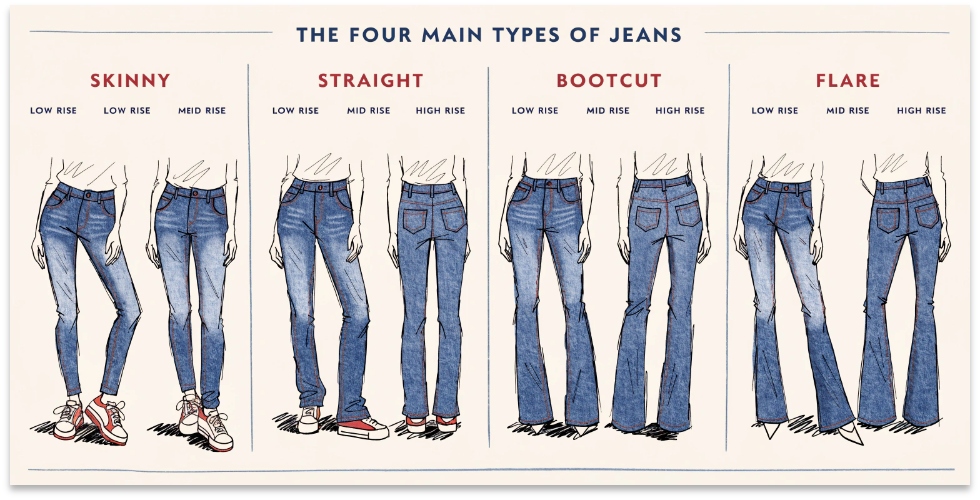
People often confuse rise with the leg cut. They are two separate things. The rise tells you where the jeans sit on your waist. The cut tells you the shape from the knee down to the ankle. In my factory, we have patterns for every possible combination. A designer might ask for a high-rise skinny jean or a low-rise bootcut jean. Understanding these two components helps you build a versatile wardrobe.
The Four Main Leg Shapes
| Leg Shape | Description |
|---|---|
| Skinny | Fits tightly from the hip all the way to the ankle. |
| Straight | Runs straight from the hip down to the ankle. A classic fit. |
| Bootcut | Is straight through the thigh and has a slight kick or flare below the knee. |
| Flare | Is fitted through the thigh and widens significantly from the knee to the ankle. |
You can find all four of these leg shapes in a low-rise style, especially if you look at vintage jeans from the early 2000s. The low-rise bootcut was one of the most popular combinations of that era.
Conclusion
Low-cut jeans are defined by their low rise, sitting on the hips. This Y2K trend can be combined with any leg shape to create a bold, specific look.
-
Discover the evolution of low-rise jeans and why they are making a comeback in fashion. ↩ ↩
-
Stay updated on the latest trends in jeans and how to incorporate them into your style. ↩
-
Learn about the importance of rise measurement in finding the perfect fit for your jeans. ↩
-
Learn about the extreme low-rise style known as bumsters and its fashion significance. ↩
-
Get tips on creating a versatile denim wardrobe by understanding different styles and rises. ↩