Skip to content

You craft a pair of jeans with perfectly straight side seams, but after the first wash, they've twisted toward the front. It’s a frustrating problem that can ruin a clean design. I'm here to explain this denim-specific quirk.
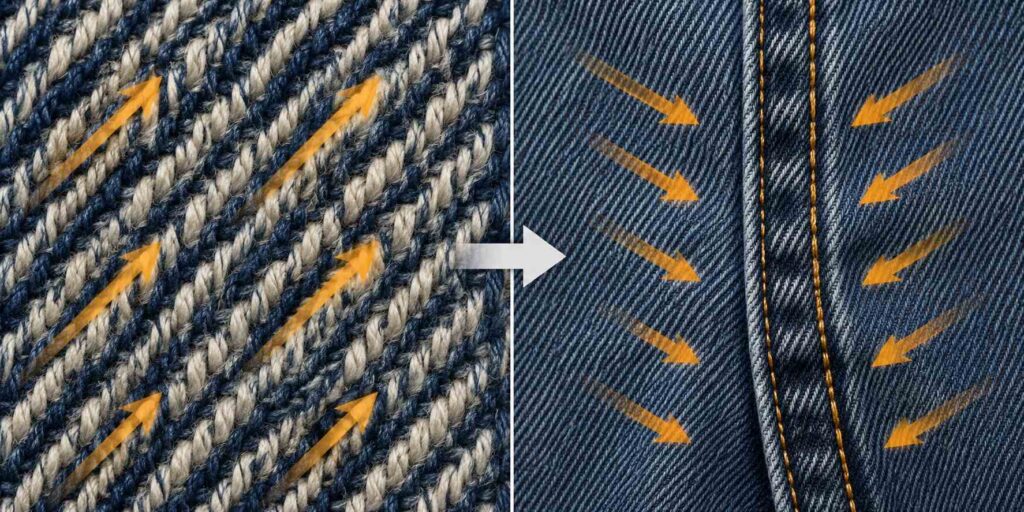
This is called "leg twist" or "skewing[^1]." It's caused by the natural tension in denim's diagonal twill weave[^2]. When washed, the fabric shrinks and wants to follow this diagonal grain[^3], pulling the straight side seam with it.
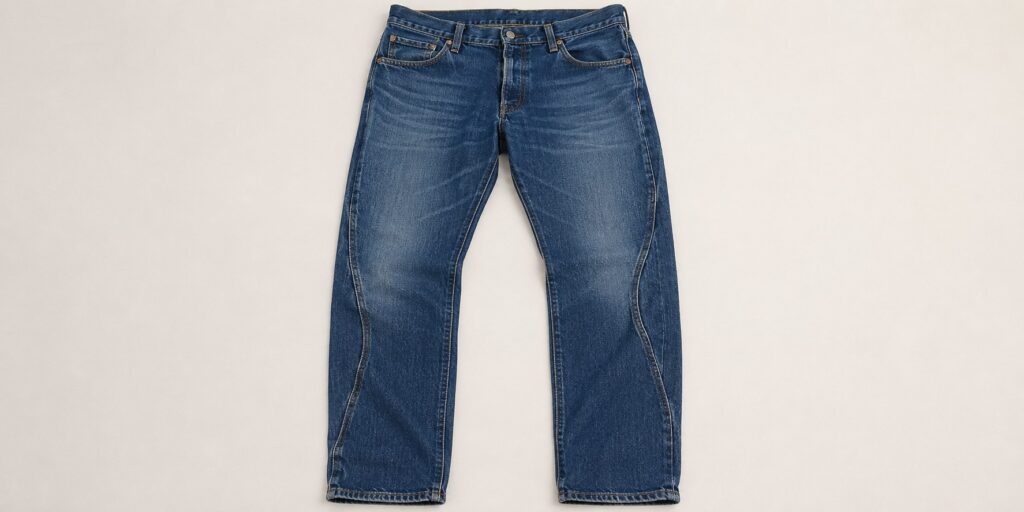
In my two decades of running a denim factory, I’ve seen this countless times. It's a natural characteristic of the fabric we love. For a designer like you, the interesting part is the debate: is this a quality defect or a mark of authenticity? The answer depends on what kind of jean you're trying to create. Let's dig into the science and the artistry of this phenomenon.
What causes seams to twist when sewing a jean?
You nail the sewing, but the leg still twists. It feels like a production error, but the cause is hidden in the fabric itself. Let's expose the true culprit.
Seam twist is caused by the inherent tension within denim's diagonal twill weave. During washing and drying, the fabric's fibers relax and shrink, naturally pulling along the diagonal lines of the twill and forcing the straight leg seam to twist.
Dive Deeper: A Defect or a Vintage Feature?
In our industry, we call this "skewing" (or ). It happens because the warp and weft yarns have different tensions. When agitated with water, the fabric settles into its most natural state, which follows the diagonal twill. In most of the fashion world, this is considered a production flaw.[^4] My factory, like most, uses special processes to prevent it. However, a niche group sees it differently.
Hardcore denim purists—the "raw denim" fans—often see leg twist as a badge of honor. To them, it signifies that the denim is in its most authentic, unprocessed state. It's a sign of vintage character. Some high-end Japanese brands might even intentionally allow for leg twist to appeal to this market. So, as a designer, you face a choice. Do you want flawless construction or raw, authentic character?
| Perspective | View on Leg Twist | Why? |
|---|---|---|
| Mass-Market Fashion | A production defect. | Customers expect straight, symmetrical seams. It looks like a mistake. |
| Denim Purists | A desirable feature. | Signifies authentic, un-sanforized raw denim and vintage appeal. |
How to fix a twisted jean leg?
Your favorite jeans now have a twisted leg. It can make them hang strangely and feel off. Is there any way to reverse it? I'll give you the straight answer.
Unfortunately, you cannot permanently fix a twisted jean leg once it has set. The twist is the fabric's new natural shape. Trying to iron it straight is only a temporary fix that will vanish after the next wash. The only real solution is prevention.
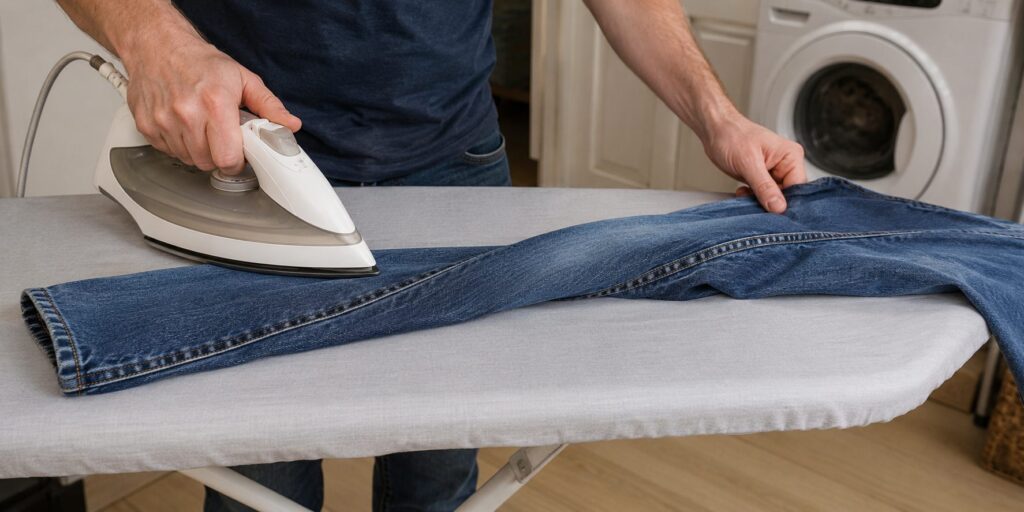
Dive Deeper: Prevention is the Only Cure
Since you can't fix leg twist after the fact, our work in the factory is all about stopping it before it starts. This is where craftsmanship and technology come together. If you want a perfectly straight leg seam that stays straight, my team and I have several key techniques we use to fight the fabric's natural tendencies.
First, we can use fabric that has been "Sanforized," a process that pre-shrinks and stabilizes the denim[^5]. For unsanforized fabric, our pattern makers can actually cut the leg pattern on a slight twist in the opposite direction. This compensates for the skewing that will happen in the wash. We can also use a process called "stentering" to straighten the weft yarns before cutting. All these steps add complexity, but they are essential for creating a stable, predictable garment for the mainstream market.
| Technique | How It Prevents Leg Twist |
|---|---|
| Pre-Shrinking (Sanforization) | Removes most of the shrinkage from the fabric before sewing, making it stable. |
| Pattern Compensation | The pattern is cut at a slight skew to anticipate and counteract the direction the fabric will twist. |
| Weft Straightening | A machine process that pulls the fabric to align the weft yarns perfectly, releasing internal tension. |
| Sewing & Cutting Precision | Ensuring every piece is cut and sewn perfectly on-grain minimizes any small errors that can worsen twist. |
How to stop ends of jeans from curling?
Your jeans look great, but the bottom hems keep curling up after you wash them. This annoying little detail can ruin a sharp silhouette. Let's look at the fix.
Hems curl because the raw, cut edge of the fabric naturally wants to roll. The solution is a well-constructed hem—like a chain-stitched or lock-stitched felled seam—that encases the raw edge and adds structure, physically preventing it from curling.
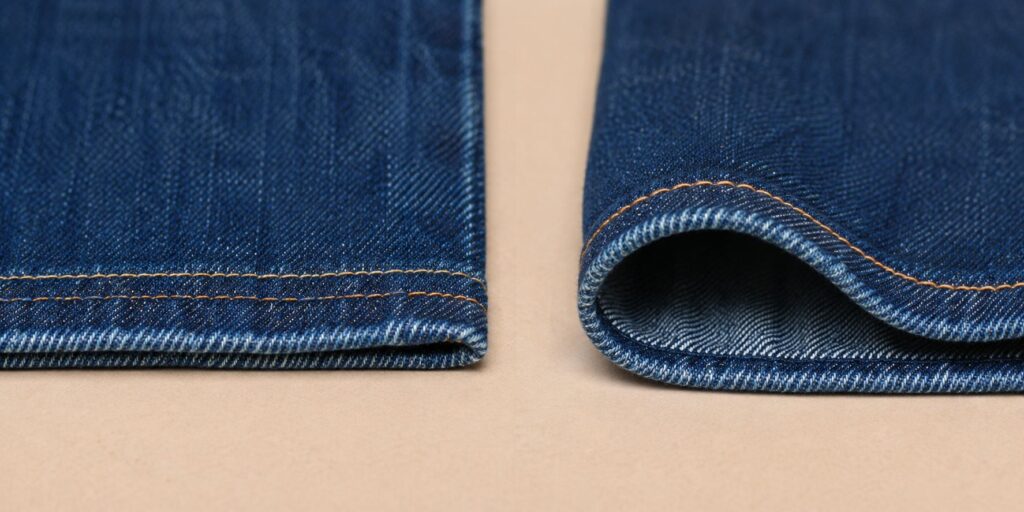
Dive Deeper: The Importance of a Strong Hem
While seam twisting is about the whole leg, hem curling is a battle fought at the very edge of the fabric. The way we finish that final inch of the jean is critical. A simple, flimsy fold-over hem just won't cut it on sturdy denim; it lacks the weight and structure to fight the fabric's desire to curl.
This is why traditional denim construction is so important. A classic chain-stitched hem is the gold standard[^6]. Not only does it create a beautiful "roping" fade over time, but the stitch construction itself provides a durable, rigid finish that holds the hem flat. It fully encases the raw edge and adds just enough tension and weight to keep it from flipping up. Using a heavier-gauge thread also contributes significantly. It’s a small detail that makes a huge difference in the finished quality and longevity of a pair of jeans. For a designer like you, specifying the right hem is just as important as choosing the right fabric.
What is the 2 finger rule for jeans?
You're assessing a sample, but how do you judge the fit instantly? This simple, time-tested rule gives you a clear answer about the most important part: the waist.
The two-finger rule is a quick test for the waistband's fit. You should be able to slide two fingers snugly between your waist and the waistband. This confirms the jeans have enough ease for comfort without being too loose.
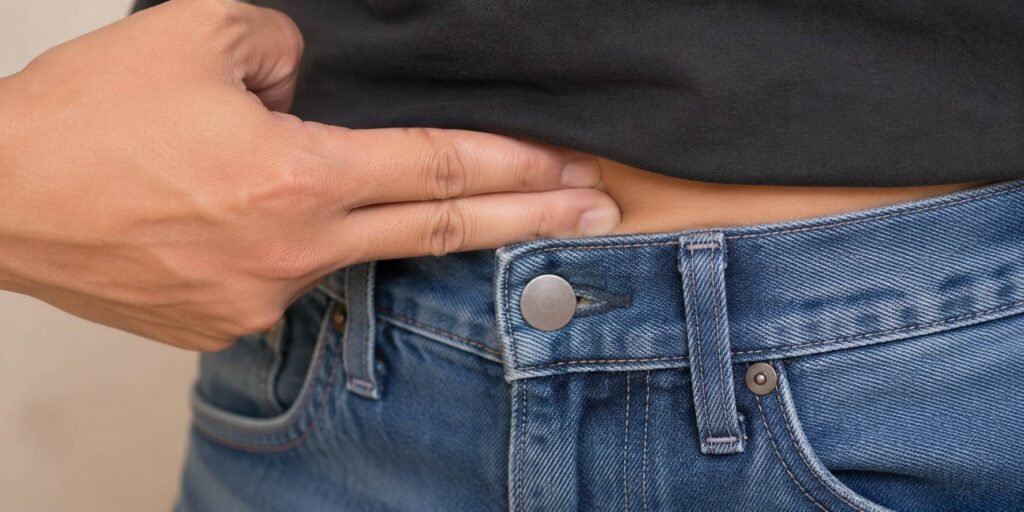
Dive Deeper: How Fit Affects Fabric Integrity
This rule might seem like just a customer tip, but it has real implications for the life of the jeans and the integrity of our work. When a waistband is too tight, it puts the entire top block of the jeans under constant, excessive stress. This strain pulls on the seams, the hardware, and the fabric itself.
While a tight fit won't directly cause leg twist, it will absolutely accelerate wear and tear along every seam line, including a twisted one. An overly tight fit can distort the way the fabric is meant to hang and drape, potentially making any slight imperfections more noticeable. As a partner in your creative process, I see it this way: you design the ideal fit, and I ensure the construction is robust enough to handle the wear that fit will experience. A proper fit, with that little bit of two-finger ease, allows the garment to look and perform exactly as we intended.
Conclusion
Leg twist is the perfect example of denim's unique character. It's a battle between raw fabric and precision engineering. Understanding this lets us choose between authentic imperfection and flawless modern construction.
This is why traditional denim construction is so important. A classic chain-stitched hem is the gold standard. Not only does it create a beautiful "roping" fade over time, but the stitch construction itself provides a durable, rigid finish that holds the hem flat. It fully encases the raw edge and adds just enough tension and weight to keep it from flipping up. Using a heavier-gauge thread also contributes significantly. It’s a small detail that makes a huge difference in the finished quality and longevity of a pair of jeans. For a designer like you, specifying the right hem is just as important as choosing the right fabric.
## What is the 2 finger rule for jeans?
You're assessing a sample, but how do you judge the fit instantly? This simple, time-tested rule gives you a clear answer about the most important part: the waist.
The two-finger rule is a quick test for the waistband's fit. You should be able to slide two fingers snugly between your waist and the waistband. This confirms the jeans have enough ease for comfort without being too loose.

### Dive Deeper: How Fit Affects Fabric Integrity
This rule might seem like just a customer tip, but it has real implications for the life of the jeans and the integrity of our work. When a waistband is too tight, it puts the entire top block of the jeans under constant, excessive stress. This strain pulls on the seams, the hardware, and the fabric itself.
While a tight fit won't directly cause leg twist, it will absolutely accelerate wear and tear along every seam line, including a twisted one. An overly tight fit can distort the way the fabric is meant to hang and drape, potentially making any slight imperfections more noticeable. As a partner in your creative process, I see it this way: you design the ideal fit, and I ensure the construction is robust enough to handle the wear that fit will experience. A proper fit, with that little bit of two-finger ease, allows the garment to look and perform exactly as we intended.
# Conclusion
---
[^1]: "(PDF) Skewness and Spirality of Knitted Structures - Academia.edu", https://www.academia.edu/102245710/Skewness_and_Spirality_of_Knitted_Structures. Textile-testing literature defines fabric or garment skewness as angular distortion from the intended grain or seam alignment, providing the technical context for describing denim leg twist as skewing. Evidence role: definition; source type: paper. Supports: The denim phenomenon called leg twist is also known as skewing.. Scope note: The source may define skewness broadly for textiles rather than specifically for jeans.
[^2]: "Weave Structure and the Skewness of Woven Fabric - Academia.edu", https://www.academia.edu/6572636/Weave_Structure_and_the_Skewness_of_Woven_Fabric. Textile-engineering sources describe twill fabrics as having diagonal wale structures that can create directional distortion and skew during relaxation or laundering, supporting the mechanism proposed for denim leg twist. Evidence role: mechanism; source type: paper. Supports: Leg twist is caused by tension associated with denim’s diagonal twill weave.. Scope note: This supports the general fabric-mechanics explanation; the exact amount of twist depends on yarn, weave, finishing, and washing conditions.
[^3]: "The effect of fabric structure parameters on dimensional stability ...", https://www.academia.edu/111358273/The_effect_of_fabric_structure_parameters_on_dimensional_stability_after_domestic_washing. Research on laundering-induced dimensional change in woven cotton fabrics shows that washing can relax yarn tensions and produce shrinkage or distortion, which is consistent with twill denim moving along its diagonal grain. Evidence role: mechanism; source type: paper. Supports: Washing causes denim shrinkage and relaxation that can pull fabric along the diagonal twill grain.. Scope note: The source would support laundering-related relaxation and shrinkage generally, not necessarily every denim construction.
[^4]: "Preventing Leg Twist in Denim Jeans | PDF | Seam (Sewing) - Scribd", https://www.scribd.com/document/295411182/Leg-Twist-Jeans. Garment-quality-control materials treat twisted legs, seam spirality, or fabric skewness as measurable defects affecting appearance and conformance, supporting the claim that mainstream production commonly regards leg twist as a flaw. Evidence role: expert_consensus; source type: institution. Supports: Mainstream garment production generally treats leg twist as a quality defect.. Scope note: Quality standards vary by brand, market segment, and intentional design choices.
[^5]: "Brückner Sanforizing Machine: Pre-shrinking and stabilizing fabrics", https://www.linkedin.com/posts/syedmuneebali1_description-a-br%C3%BCckner-sanforizing-machine-activity-7361269689244692480-7Lm2. Standard textile references describe Sanforization as a controlled compressive-shrinkage finishing process used to reduce residual shrinkage in woven fabrics, supporting its role in stabilizing denim before garment manufacture. Evidence role: definition; source type: encyclopedia. Supports: Sanforization is a pre-shrinking process that stabilizes denim.. Scope note: Sanforization reduces shrinkage but does not guarantee complete elimination of all distortion or seam twist.
[^6]: "Original Hem vs Chain Stitch Hem: Why Jeans Shouldn't Have Seams", https://williamsburggarment.com/hems-shouldn-t-have-seams/?srsltid=AfmBOopsgHNALE_I2AyIq8JYIE-zQsL6OfmvXZ_HPXAwu6Z-FTkB4Wyi. Garment-construction references describe chain stitching as a durable seam type commonly used in denim hems and workwear construction, supporting the claim that it is a traditional and structurally robust denim finish. Evidence role: historical_context; source type: education. Supports: Chain-stitched hems are a traditional, durable construction method for denim jeans.. Scope note: The phrase “gold standard” is evaluative; evidence can support common traditional use and durability, not objective superiority in every application.