Skip to content

You're launching a new collection, but your order quantity is a total guess. You're terrified of ordering too much and wasting cash, or ordering too little and missing out on sales.
Effective forecasting support means your factory acts as a partner. They help analyze data, offer flexible MOQs1, and adjust production based on your real-time sales, turning guessing into a predictable growth strategy2.

I once worked with a sharp e-commerce brand that had a pair of jeans unexpectedly go viral on TikTok. They sold out in 48 hours. They called me in a panic, desperate for a reorder.
But because we hadn't planned for this, their new production run was at the back of a 12-week queue. By the time the jeans were restocked, the viral moment had passed. They missed out on a massive sales opportunity.
For a visionary designer like my client Dean, who needs to capitalize on market trends instantly, this kind of reactive planning is a brand killer. This is why forecasting isn't just about numbers; it's about building a responsive supply chain with your factory partner.
Can they help project demand by region and channel?
You're selling in the US and EU, but unsure of the demand split. You risk sending the wrong inventory to the wrong fulfillment center, creating logistics nightmares and lost sales.
A factory can't know your specific customers, but an experienced one provides historical production data3 on similar styles. This data helps you build a much smarter forecast model for each region.

While I can't be your market analyst in New York or London, I can give you powerful data from my 20 years on the factory floor.
I can't tell you if your new design will sell, but I can tell you how similar designs are behaving. For example, you might be deciding on the volume split for a new relaxed-fit jean.
I can pull my data and tell you, "Over the last six months, 70% of our production for US-based brands was for relaxed and loose-fit styles, while 60% of our orders for EU brands were still focused on slim and straight-leg fits." This isn't a prediction, but it's a huge clue.
It helps you shift your forecast from a pure guess to a data-informed strategy4. This way, you allocate your inventory budget more intelligently from the start.
| Data Point We Can Provide | How It Helps Your Forecast |
|---|---|
| Fit Popularity by Region | Helps you decide volume split between US and EU markets. |
| Wash Trend Data | Informs how much to invest in light vs. dark washes. |
| Fabric Weight Trends | Guides decisions on seasonal fabric choices. |
What data informs MOQ and reorder timing5?
Your factory's MOQ is too high for a test run. You're forced to risk a huge amount of capital on a style you haven't even validated with your customers yet.
MOQ isn't arbitrary; it's based on fabric mill minimums and production efficiency. Reorder timing is driven by raw material lead time (4-6 weeks) plus production (4-5 weeks). You should plan for a 10-12 week cycle.
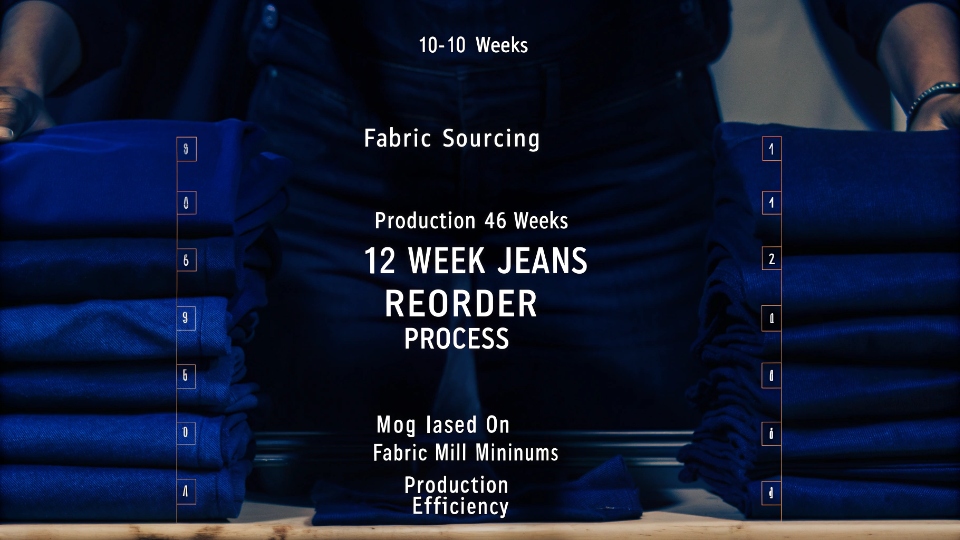
Many designers think we just invent MOQ numbers. The reality is tied to our own supply chain. The biggest driver is the fabric mill.
They often require us to purchase a minimum of 3,000 yards of a specific custom denim. To run our large-scale dyeing and washing machines efficiently, we also need a certain number of garments per batch.
However, a true partner finds ways to be flexible. If you want to order a smaller quantity of a standard 12oz blue denim, I can often group your order with another client's order that uses the same fabric, allowing both of you to meet the mill's minimum.
For reorder timing, you have to work backward from your "in-stock" date. The clock starts the moment you say "go."
Sample Reorder Timeline
- Weeks 1-4: Order and receive bulk fabric and trims.
- Weeks 5-7: Cut the fabric and sew the garments.
- Weeks 8-9: Garment washing, dyeing, and finishing.
- Week 10: Final Quality Control (QC), packing, and prep for shipping.
Understanding this timeline is crucial for forecasting when you need to place your reorders to avoid stockouts.
How do they update forecasts mid-season?
Your star product is selling out twice as fast as you expected. But by the time you realize it, your next shipment is still months away and you're losing sales every single day.
We update forecasts by working with a rolling forecast you provide monthly. This allows us to pre-book production capacity or hold safety stock of your core fabric, cutting down reaction time significantly.

The key to mid-season agility is communication and planning. The most successful brands I work with don't just send a PO and disappear. They share their sales data. This doesn't have to be complex; a simple monthly email with a sales forecast for the next three months works wonders.
If you tell me you project selling 1,000 units of your signature jean per month, I can take action. I can reserve a production line for you or, even better, secure a "blanket order" for your custom fabric.
This means we commit to 10,000 yards of your denim from the mill, but you only give me production orders (or "release orders") for 2,000 units at a time based on your real-time sales. This simple strategy can cut your reorder lead time in half because the biggest variable—fabric delivery—is already taken care of.
Can forecast errors be adjusted without penalty?
You over-forecasted and now have an order for 1,000 jeans in the system, but you only need 500. Your cash is about to be tied up in inventory that will just sit in a warehouse.
Adjustments without penalty depend entirely on timing and communication. If we know before the fabric is cut, we have options. A true partner will work to find a solution, not punish you.
![A factory manager pointing to a roll of fabric marked 'Hold for [Client Name]' in a warehouse.](https://diznewjeans.com/wp-content/uploads/2025/11/adjustments-without-penalty-depend-entirely-on-t.jpg "Adjusting Forecast Errors Without Penalty")
Mistakes happen. Forecasts are never perfect. A factory's response to an error tells you everything about the partnership. The most critical moment is when the fabric is cut. Before that point, we are flexible.
If you tell me you need to reduce your order from 1,000 to 500 units after the fabric has been ordered, we can work it out. The best solution is for us to hold the excess fabric for your next order.
We are happy to do that for our long-term partners. If you under-forecast and suddenly need more, the challenge is production capacity. If our lines are full, we might have to run an overtime shift.
This may come with a small rush fee, not as a penalty, but to cover the real cost of paying our workers more for the extra hours. The goal is always to find a collaborative solution6 that protects your business.
| Scenario | Our Collaborative Solution |
|---|---|
| You Over-forecast (before fabric is cut) | We reduce the order and hold the excess fabric for your next run. |
| You Under-forecast (and need a rush) | We try to fit you in; if overtime is needed, we discuss the cost transparently. |
| You Cancel a Style (after fabric is ordered) | We work with you to use that fabric for a different style in your collection. |
Conclusion
Forecasting isn't about having a crystal ball. It’s about partnering with a factory that gives you the data, flexibility, and communication to turn market uncertainty into a predictable growth strategy.
-
Learn about flexible Minimum Order Quantities and how they can help reduce financial risk in production. ↩
-
Understand the components of a predictable growth strategy and how to implement it. ↩
-
Find out how historical production data can improve your forecasting accuracy and inventory management. ↩
-
Understand how a data-informed strategy can lead to better decision-making and forecasting. ↩
-
Understand the key factors that affect Minimum Order Quantities and reorder timing for better planning. ↩
-
Find out how collaborative solutions can improve partnerships and problem-solving in supply chains. ↩