Skip to content

You placed a big order weeks ago, but now you're in the dark. You get vague emails saying "everything is on track," but you have a sinking fear that problems are piling up.
You can ensure transparency by establishing and tracking specific Key Performance Indicators (KPIs)1. Objective data on on-time delivery, defect rates, and quality consistency replaces empty promises and gives you a true picture of performance.

Trust is critical, but trust must be verified with data. I once took over a project for a brand whose previous supplier swore everything was fine until one week before the ship date.
Suddenly, a "small delay" became a six-week disaster because the unique denim wash was failing quality checks. The factory knew for a month but hid the bad news. This cost my client a full retail season.
When they moved their production to me, the first thing we did was set up a clear KPI dashboard2. They never had a surprise like that again. Data doesn't lie, and a good partner isn't afraid to share it.
What metrics measure on-time delivery and defect rates?
You are told your order is "on time" and "good quality." But these are vague promises that can lead to arguments when your expectations don't match the final outcome.
We measure On-Time Delivery Rate (OTDR)3 as the percentage of orders shipped on or before the agreed date. We measure quality using a strict Acceptable Quality Limit (AQL)4 standard, which clearly defines and counts defects.

We have to speak the same language, and that language is numbers. Simply tracking the final ship date isn't enough. We track key production milestones to catch delays early.
This includes fabric arrival, the start of cutting, sewing completion, and washing completion. If cutting is delayed by three days, we know immediately that we have to make up that time later.
For quality, we use the AQL 2.5 standard. This means that in a random inspection, we accept a shipment if we find no more than a very small, pre-agreed number of minor and major defects.
This removes all subjectivity. We define everything. A loose thread is a minor defect. A hole in the fabric is a major defect. By using these clear, measurable KPIs, we replace opinions with facts.
| Key Performance Indicator (KPI) | How We Measure It | Target |
|---|---|---|
| On-Time Delivery Rate (OTDR) | % of orders shipped on or before the PO date. | > 98% |
| Defect Rate (AQL) | % of defective units found during final inspection. | AQL 2.5/4.0 |
| Size Accuracy Rate | % of garments within +/- tolerance of the spec sheet. | 100% |
| Wash Fastness Consistency | Pass/Fail rating on color bleed and fading tests. | 100% Pass |
How often do we review supplier performance5?
You've agreed on KPIs, but if you don't check in regularly, problems can build up silently. By the time you review the numbers, it's often too late to fix the issues.
We establish a firm rhythm. This includes quick weekly check-ins for timelines, detailed monthly reviews on all KPIs, and strategic quarterly meetings to discuss long-term goals and process improvements.

A good partnership runs on communication. Leaving reviews until the end of an order is a recipe for failure. Our process creates a constant feedback loop.
The weekly check-ins are very brief, often just an email with status updates on key milestones. It’s a simple "Are we on schedule? Yes or No." The monthly reviews are more formal video calls.
We share a screen and go through the KPI report together. We look at the on-time delivery rate, the defect numbers from our QC team, and any other metrics we agreed on. If a number is red, we discuss why.
This is a problem-solving session, not a blame game. The quarterly business reviews are higher-level. We look at the performance trends over the past three months. Are our improvements working?
What can we do better for your next collection? This regular rhythm ensures we are always aligned and that small issues never become big surprises.
You get weekly reports from your factory, but you can't shake the feeling that they are only showing you the good news. You need real-time data to feel confident.
Yes, a transparent partner should provide direct access to the data. We use shared online spreadsheets or a simple dashboard that shows you real-time production numbers and quality reports, building complete trust.

Of course. Hiding data is a huge red flag. My goal is for you to feel like you have a window right into my factory floor. For most of my clients, like Dean, the simplest and most effective tool is a shared Google Sheet.
It’s our single source of truth. My production supervisors update it at the end of every day. You can log in from New York or anywhere else and see exactly how many units were cut, sewn, and passed inspection that day.
The sheet will show the daily output versus our target, the number of defects found, and a short description of each defect. This raw data access is powerful. It allows you to cross-reference our numbers with reports from your own third-party inspector.
If our data aligns with theirs, it builds incredible confidence. If there's a discrepancy, it gives us a clear point to discuss immediately.
What improvement plans follow low scores?
You've pointed out a low score on a KPI. The factory promises to "do better next time," but the same mistake happens again on the next order, breaking your trust.
A promise is not a plan. When a KPI is missed, we issue a formal Corrective Action Plan (CAP)6. This document details the root cause, the specific fix, who is responsible, and a deadline.
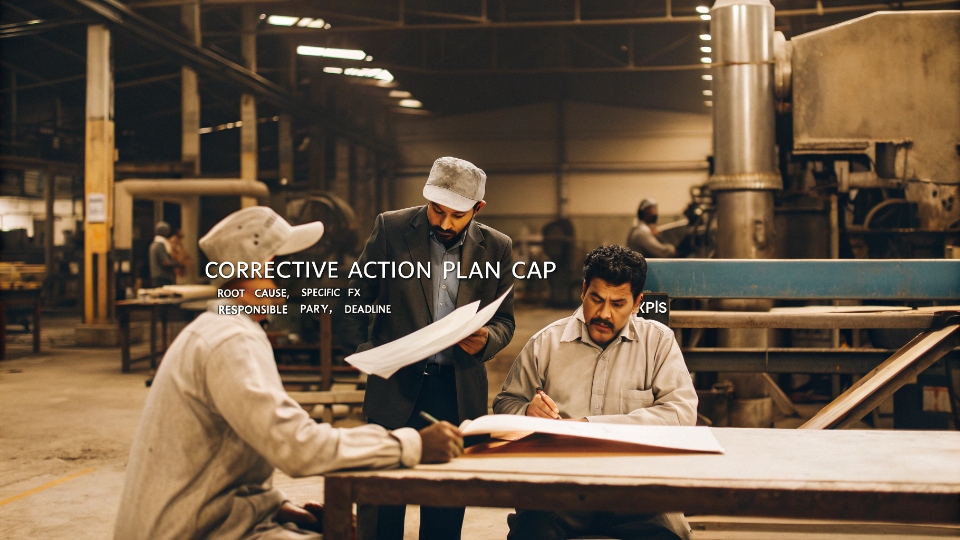
"We will improve" is the most useless phrase in manufacturing. Real improvement requires a system. If our defect rate for stitching is too high, we don't just tell the sewing team to be more careful.
We launch a formal investigation. We use a method called the "5 Whys" to find the true root cause. Was the sewing machine tension wrong? Was the thread faulty?
Was the operator not trained properly on that specific curve? Once we identify the root cause, we create the CAP.
For example: 1. Root Cause: Operator #7 was not properly trained on the new bar tacking machine. 2. Action: Retrain Operator #7 and two other operators on the new machine. 3. Responsible: Mr. Li, Sewing Floor Supervisor. 4. Deadline: End of day tomorrow. 5. Verification: QC team will inspect 100% of Operator #7's work for the next 3 days.
This creates accountability and ensures the problem is actually solved, not just patched over. This is how a professional partnership works.
Conclusion
Tracking KPIs isn't about finding fault. It's about creating a transparent, data-driven partnership that solves problems early, guarantees quality, and ensures we both succeed together.
-
Understanding KPIs is crucial for measuring performance and ensuring transparency in manufacturing processes. ↩
-
A KPI dashboard provides real-time insights into performance metrics, enhancing transparency. ↩
-
Learn how OTDR is calculated to ensure your orders are delivered on time and meet expectations. ↩
-
Explore AQL standards to understand how quality is measured and maintained in production. ↩
-
Regular reviews of supplier performance are crucial for maintaining quality and timely delivery. ↩
-
Learn about CAPs and how they help address and resolve quality issues effectively. ↩