Skip to content

Your customers feel stuck. Regular fits feel too dated and baggy, but a true slim fit feels too tight and restrictive. You need to design a jean that captures that perfect middle ground.
Yes, the "slim-straight" fit is the ideal bridge between a slim and regular cut. It combines the tailored thigh of a slim fit with the classic comfort of a straight leg from the knee down.

Dean, your insights about the Levi's 513 are spot-on. That fit is a perfect case study for this "in-between" space.In my factory, we refer to this category as a slim-straight, and it's one of the most commercially successful patterns we produce for modern menswear brands.
It solves a core problem for the customer who has outgrown skinny jeans but isn't ready for a full-on classic regular fit. It’s all about taking the best of both worlds: a clean, modern silhouette through the top block and thigh, combined with a timeless, comfortable leg.
What Is the Difference Between Slim Fit and Regular Fit Jeans?
Your team needs clear, technical definitions to design effectively. "Slim" and "Regular" can be subjective, leading to inconsistent samples and a confusing final product for the customer.
The primary difference is in the measurements of the seat, thigh, and leg opening. A slim fit is cut closer to the body in all these areas, while a regular fit offers more room for a classic silhouette.

When a designer sends me tech packs for these two fits, I look at very specific numbers. A "Regular Fit," which we often model after a classic like the Levi's 501, is designed for function and comfort.
It has a fuller seat and thigh. A "Slim Fit," like a 511, is designed to be more fashion-forward. We cut the top block (the area from the waist to the crotch) closer to the body, significantly reduce the thigh measurement, and taper the leg down to a narrower leg opening.
The goal of a slim fit is to trace the wearer's natural shape, while the goal of a regular fit is to provide a straight, classic line from hip to ankle, regardless of the wearer's shape. It's a fundamental difference in design philosophy.
Fit Specifications: Slim vs. Regular
| Measurement Point | Regular Fit (e.g., Levi's 501) | Slim Fit (e.g., Levi's 511) |
|---|---|---|
| Seat & Thigh | Full, providing ample room | Cut close, follows body shape |
| Knee | Straight from thigh | Tapered and narrower |
| Leg Opening | Wider (approx. 16-17") | Narrow (approx. 14.5") |
| Overall Silhouette | Classic, straight | Modern, tailored |
What Is the Sweet Spot Between Straight and Skinny Jeans?
You know the market needs something more modern than a classic straight leg, but your customer isn't a 20-year-old who wants to wear ultra-tight skinny jeans. How do you design for that gap?
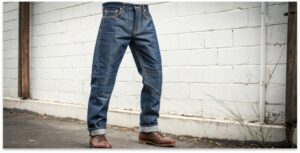
The slim-straight fit is the answer. It borrows the slim thigh from a skinny jean but adopts a straight leg from the knee down, avoiding the restrictive, tapered ankle of a true skinny fit.

This is exactly where the Levi's 513 archetype you mentioned comes into play. It’s the perfect design solution. When we develop this pattern, we start with a slim fit top block.
The seat and thigh are tailored and clean. The magic happens from the knee down. Instead of continuing the aggressive taper of a skinny jean (like a 510), we run the leg straight down to the ankle.
This creates a leg opening that's maybe an inch or so wider than a slim fit, but still much cleaner than a regular fit. This design is incredibly versatile.
It gives the modern, tailored look that men want, but it's comfortable and doesn't create that "ice cream cone" silhouette that many men want to avoid. It’s a sophisticated, mature take on a slim silhouette.
What Is the Opposite of a Slim Fit Jean?
When a client asks for "the opposite of slim," you need to know what to show them. "Regular" isn't always the right answer, as it's just one point on a much wider spectrum of relaxed fits.
There isn't one single opposite. It's a spectrum that includes Regular, Relaxed, and Loose fits. Each offers progressively more room in the seat and thighs, moving further away from the body-hugging slim silhouette.

This is a key area where precise language helps a brand succeed. On the factory floor, these terms correspond to specific pattern adjustments.
- Regular Fit: This is the classic baseline. It's a straight-leg silhouette with a comfortable but not excessive amount of room in the seat and thigh. Think of it as the neutral starting point.
- Relaxed Fit: This is the first true step away from slim. We add more room to the seat and thighs compared to a regular fit. The leg is still typically straight, but the overall feel is looser and more casual.
- Loose/Baggy Fit: This is the true opposite end of the spectrum. This fit is defined by volume everywhere. It has a low crotch, a very full seat and thigh, and a wide leg all the way down. It's a specific, fashion-forward choice driven by street-style trends.
Understanding this spectrum allows you to guide your clients to the exact level of comfort and style they're looking for beyond a simple slim fit.
Do I Need to Size Up for a Slim Fit?
A customer tries on a slim-fit jean in their usual size and it feels too tight. This creates a negative fitting room experience and can cause them to abandon the style altogether.
Not necessarily. The need to size up often depends more on the jean's rise and fabric. A low-rise jean sits on the wider hips, and rigid, non-stretch denim has no give, both of which can make a size feel smaller.
Your notes on this are perfect, Dean. Two critical factors are at play here that go beyond just "slim fit." First is the rise. As you said, a low-rise jean (like the 513 or 514) sits below the natural waist.
For most men, this area around the hips is wider than their actual waist measurement. So, they need a larger size to accommodate this, not because the jean is slim, but because of where it sits.
Second is the fabric. A 100% cotton, rigid denim has zero stretch. A slim fit in this fabric will feel much more restrictive. This is why a fabric with 1% or 2% elastane is so common in slim fits.
That tiny bit of stretch provides crucial comfort and mobility, allowing the jean to hug the body without constricting it. It makes the difference between a jean that feels painted-on and one that feels perfectly tailored.
Conclusion
The slim-straight jean is the expert solution. It perfectly fills the gap between slim and regular, offering a modern, tailored look with timeless comfort that appeals to a broad range of customers.