Skip to content

You've designed countless jean silhouettes, from sleek to relaxed. Then you remember the 90s and a specific brand that defied all logic: JNCO. How did jeans with 50-inch leg openings become a phenomenon?
JNCO jeans1 became popular as a symbol of rebellion in 90s youth counter-culture. Their ridiculously wide legs were an anti-fashion statement embraced by ravers, skaters, and goth subcultures2 who wanted to stand apart from the mainstream.
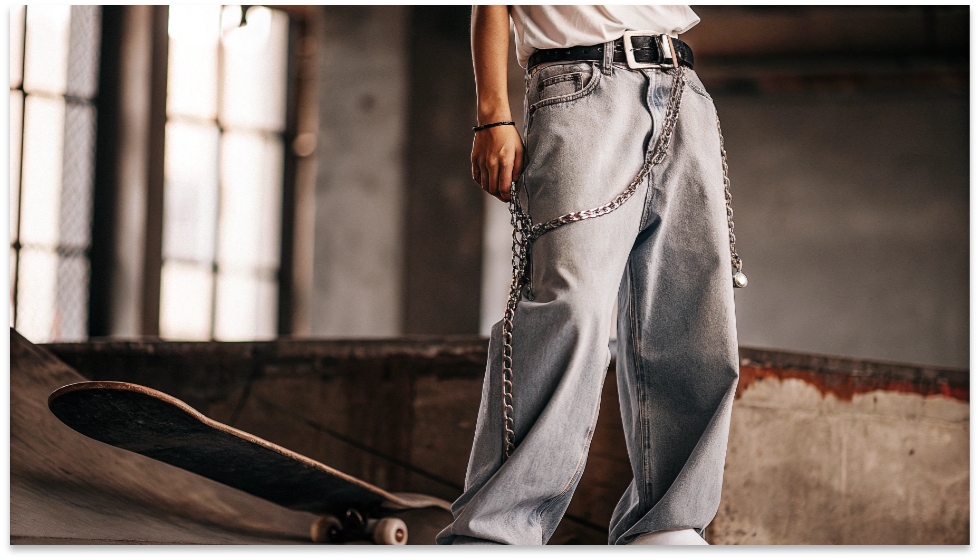
Dean, as someone who has spent his life manufacturing jeans, the JNCO era was something else. I remember getting the first tech packs for designs with 40-inch, then 50-inch, leg openings.
My first thought was, "This has to be a mistake." It broke every rule of traditional pattern making. But the orders kept coming. It was a powerful reminder that sometimes, fashion isn't about flattering the body or elegant lines.
Sometimes, it's about pure, unfiltered attitude. You saw it on the streets of New York, but on my factory floor, I saw it in the sheer volume of denim we had to order just to make a single pair.
What Made JNCO Jeans So Popular?
You understand trends, but the JNCO craze seems extreme. What specific cultural forces could make such an impractical garment a must-have item for an entire generation of kids?
JNCOs became popular because they were a wearable flag for 90s counter-culture3. They visually connected kids in the rave, skate, and goth scenes, offering a bold rejection of the preppy and hip-hop styles that dominated mainstream fashion.
The popularity wasn't about looking good in a traditional sense; it was about being seen and belonging to a tribe. Your insight about them being for the "freaks" is exactly right. In the 90s, if you weren't into the mainstream preppy look or the dominant urban hip-hop style, you needed your own uniform. JNCO provided that.
The bigger the leg opening, the more you were committing to the subculture. It was a signal to others that you listened to techno or nu-metal, you went to raves, or you spent your weekends at the skate park.
From a production view, the designs themselves were intricate. We weren't just cutting wide legs4; we were adding complex embroidery of dragons, skulls, and futuristic logos. They were wearable pieces of art for these kids, and the sheer audacity of the design was its main appeal.
The Uniforms of 90s Youth
| Subculture | Key Fashion Elements | Why JNCOs Fit |
|---|---|---|
| Ravers | Bright colors, pacifiers, visors | Wide legs allowed for freedom of movement for dancing. |
| Skaters | Baggy fit for movement, durable fabric | Offered an extreme version of the baggy style already popular in skating. |
| Goths/Punks | Dark colors, chains, band shirts | Provided a dramatic silhouette that paired well with heavy boots and chains. |
| Mainstream | Preppy (Tommy Hilfiger) or Hip-Hop (Nautica) | JNCOs were the direct opposite of these more polished, conventional looks. |
How Much Did JNCO Jeans Cost in the 90s?
You know price is a key part of a brand's story. Were these cheap novelty items, or were they a serious investment for the teenagers who coveted them?
In their mid-90s heyday, a standard pair of JNCO jeans typically retailed for about $50 to $80. More elaborate models with detailed embroidery or extreme widths could cost over $100.
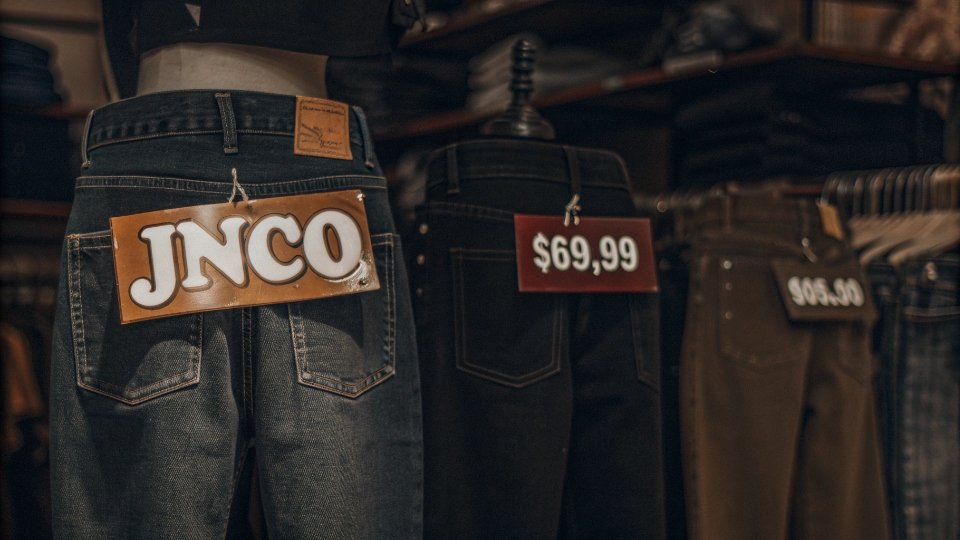
That price point is a critical detail. This wasn't fast fashion; it was a premium price for a teenager's budget in the 1990s. This made them a status symbol.
From my manufacturing perspective, the price was completely justified. A pair of JNCOs with 50-inch leg openings could use more than double the amount of denim fabric as a standard pair of Levi's 501s.That's a huge increase in raw material cost right from the start. Then you factor in the labor.
The elaborate embroidery5—like a giant dragon snaking down the leg—required complex and time-consuming machine work. The pockets were oversized, the branding was bold, and the construction had to be durable enough for skaters.
When you added up the fabric, the labor, and the branding, a $70 price tag was actually quite reasonable. It was a considered purchase that kids had to save up for, which made wearing them even more meaningful.
Were JNCOs Popular in the 2000s?
You saw the trend peak, but how long did it last? Did the new millennium bring an end to the ultra-wide-leg, or did the style carry over into the 2000s?
No, JNCOs' popularity plummeted sharply after 1999. By the spring of 2000, the trend was largely over, and the brand faded from mainstream consciousness as fashion shifted toward more fitted styles6.
Your memory is perfect. The turn of the millennium was like a light switch flicking off for the JNCO brand. On the production side, we saw orders dry up almost overnight. The cultural mood had shifted. The 90s rave and nu-metal scenes that fueled JNCO's rise were themselves fading.
As you said, new music and fashion tribes were taking over. The rise of boy bands and pop princesses brought a cleaner, more put-together look. Simultaneously, the emo and pop-punk scenes were emerging.
Those kids still wanted to be alternative, but their uniform became tighter band t-shirts and, crucially, more form-fitting jeans. The extreme bagginess of JNCO looked dated almost instantly.
As you noted, while baggy pants were still around for guys in the early 2000s, it was a more tailored, refined bagginess, not the deliberate, statement-making volume of a JNCO. The pendulum was already swinging toward what would eventually become the skinny jean era.
Why Did JNCO Jeans Go Out of Style?
Every trend dies. As a designer, understanding the cause of death is as important as knowing why it lived. What killed the king of wide-leg jeans?
JNCO jeans went out of style because the subcultures that championed them faded, and the overarching fashion pendulum7 swung aggressively toward more fitted silhouettes. Their extreme look became a caricature of the 90s, making them appear dated and uncool to the next wave of teenagers.
The fall of JNCO was a classic case of a trend being too successful and too specific. A look that is so deeply tied to a single moment in time can't survive when the moment passes.
The very thing that made them popular—their extreme, rebellious silhouette—also made them impossible to adapt. You can't just make a 50-inch leg opening a little bit narrower; the entire identity is lost. As you rightly pointed out, the 2000s brought a stylistic reset.
The nostalgia shifted from the 70s to the 80s, and with it came a move toward slimmer fits. The rise of emo culture in the mid-2000s sealed the deal. Suddenly, the coolest, most rebellious thing you could wear was the tightest pair of jeans you could find. It was the complete antithesis of the JNCO philosophy.
In my factory, we went from ordering massive quantities of denim for a single pair of pants to figuring out how to source denim with more and more Lycra and stretch. The market had completely inverted itself.
Conclusion
JNCO jeans were a 90s icon, popular as a symbol of rebellion for subcultures like ravers and skaters. Their extreme style caused their rapid rise and equally rapid fall after 1999.
-
Explore how JNCO jeans became a cultural icon and symbol of rebellion in the 90s youth counter-culture. ↩
-
Delve into the defining characteristics of goth fashion and its evolution over the years. ↩
-
Learn about the key elements that shaped the fashion of 90s counter-culture and its influence on today's styles. ↩
-
Discover the reasons behind the popularity of wide leg jeans and their significance in 90s fashion. ↩
-
Discover the intricate techniques behind elaborate embroidery and its role in fashion design. ↩
-
Explore the shift towards fitted styles in the 2000s and the cultural influences behind it. ↩
-
Learn about the fashion pendulum theory and how it explains shifts in fashion trends over time. ↩