Skip to content

You have spent weeks perfecting a design with intricate laser-engraved details and 3D whiskers. Now you have to trust a factory not to turn your art into a burnt, damaged mess.
No, a skilled factory uses calibrated CO2 lasers1 and precise digital files to remove only the surface indigo dye. This creates detailed patterns and whiskers with zero damage to the underlying cotton fibers, guaranteeing a perfect finish.
I remember when "whiskers" meant hours of tedious, dusty work. My workers would spend all day hand-sanding jeans over curved forms to create those wear lines. The results were inconsistent, and the dust was a health concern. Then came PP spray, which was faster but involved harsh chemicals.
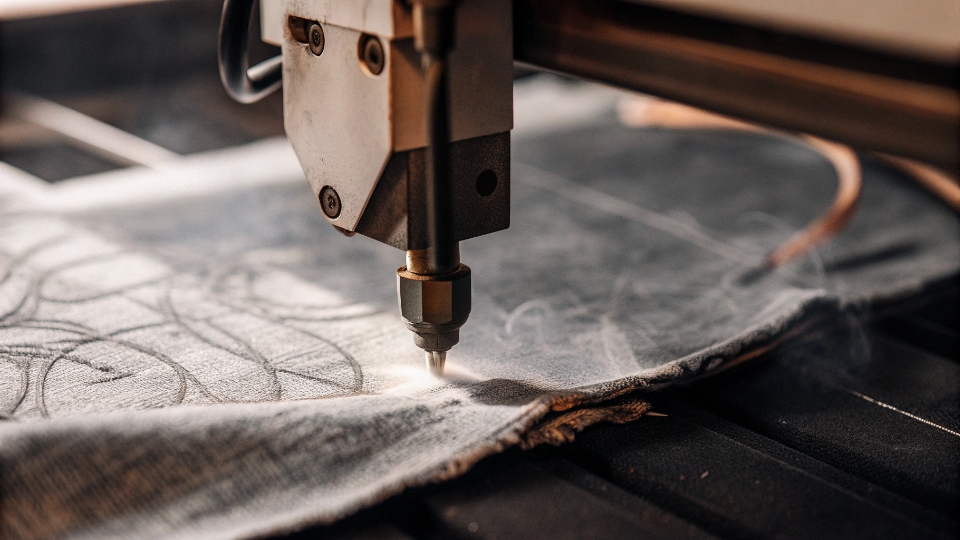
The first time I saw a laser machine in action, it was a revolution. The beam of light moved across the denim like a paintbrush, creating a perfect whisker pattern in seconds with no dust and no chemicals.
For a designer like Dean, who values precision and creativity, this technology is a game-changer. It allows him to "draw" directly onto the denim with light, and my job is to ensure we translate that digital drawing into a flawless physical garment.
Can They Program Lasers for Precise Whisker Patterns?
You have a very specific whisker pattern in mind, with unique branching and fading. You worry a factory will just apply a generic, cookie-cutter effect that ruins the custom feel of your design.
Yes, we use your digital design file2 to program the laser's exact path, speed, and power. This allows for total control, replicating everything from subtle hip whiskers to bold, stacked knee patterns perfectly.
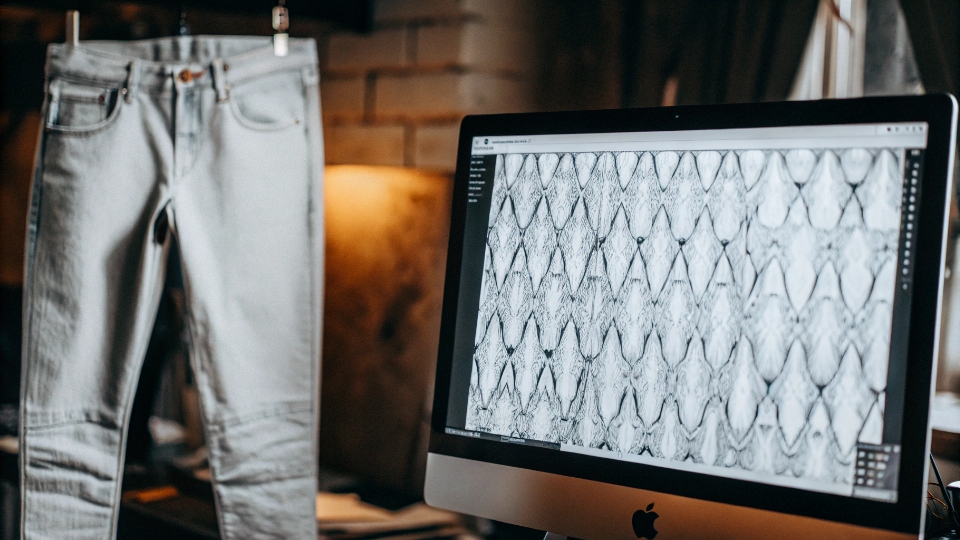
Laser whiskering is a work of digital art translated by a machine. Your vision is the starting point, and our process ensures nothing is lost in translation. It is a three-step process to perfection.
First, we take your design, typically an Adobe Illustrator or CorelDRAW file, and our technicians convert it into a set of instructions for the laser. This file tells the machine exactly where to move and how much power to use at every point to create different levels of fade.
Second, we perform a Machine Calibration. We place a test piece of the actual bulk fabric under the laser and run small test patterns to fine-tune the power and speed settings. This is crucial because different denim weights and dye contents react differently.
Third, we produce a Full Test Scan on a single garment for final verification. This ensures the placement, scale, and intensity are a perfect match for your design before we ever touch the bulk production.
What Fiber Damage Risks Exist with Laser Finishes?
You know lasers use heat, and heat can burn. You are concerned that even if the laser achieves the right look, it might weaken the fabric, leading to rips and tears after just a few wears.
The risk is minimal with a properly calibrated laser. We balance laser power, speed, and resolution (DPI) to only vaporize the surface indigo dye, leaving the underlying cotton fibers untouched and undamaged.
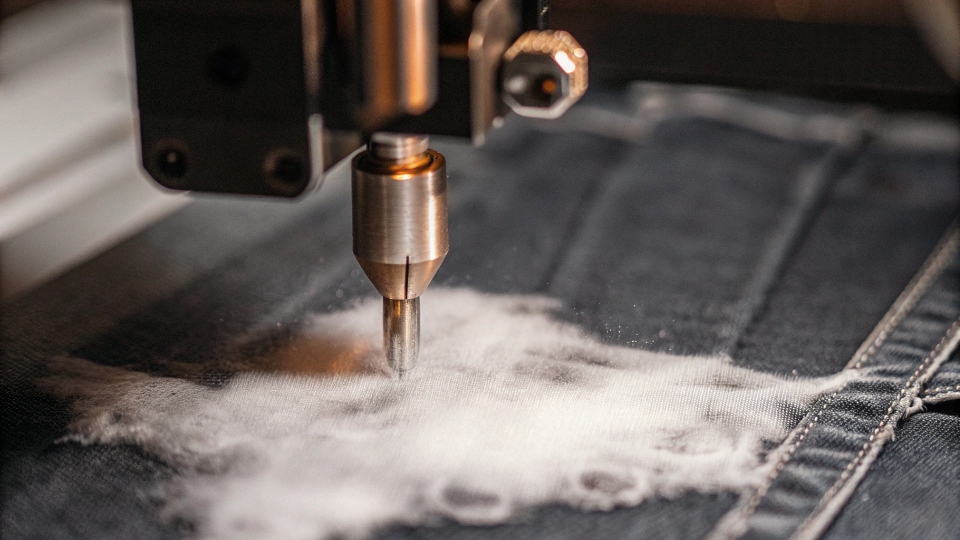
The key to preventing damage is understanding that we are not "burning" the fabric; we are performing dye sublimation3. The laser's energy is tuned to a frequency that is absorbed by the indigo dye, causing it to turn into a gas and disappear.
The white cotton core of the yarn, which reflects more light, remains cool and intact. It is a delicate balance. Too much power or moving too slowly will char the cotton.
Too little power or moving too fast will not achieve the desired lightness. This is why our R&D process is so critical. We create a "parameter matrix4" for every fabric, documenting the exact settings needed for different effects.
After any laser process, the garment goes through a final rinse. This wash not only cleans off any residual vaporized dye but also serves as a durability test, confirming the fabric's integrity.
Laser Parameter Balancing Act
| Parameter | Low Setting Effect | High Setting Effect | Risk of Damage |
|---|---|---|---|
| Power (%) | Faint, light gray mark | Bright white, deep effect | High power burns cotton. |
| Speed (mm/s) | Deeper, concentrated effect | Lighter, more diffuse effect | Slow speed causes burns. |
| DPI (Dots/Inch) | Softer, less defined look | Sharp, high-resolution image | Too high can over-stress fibers. |
How Do They Protect Surrounding Denim Areas?
Your design has a sharp, laser-engraved logo right next to a dark, untouched area of indigo denim. You worry about bleeding edges, heat haze, or discoloration ruining the clean contrast of your design.
Protection is built into the digital design file. The laser is programmed with pixel-perfect accuracy5, and it only activates over the specified areas, guaranteeing clean edges with no impact on the surrounding fabric.
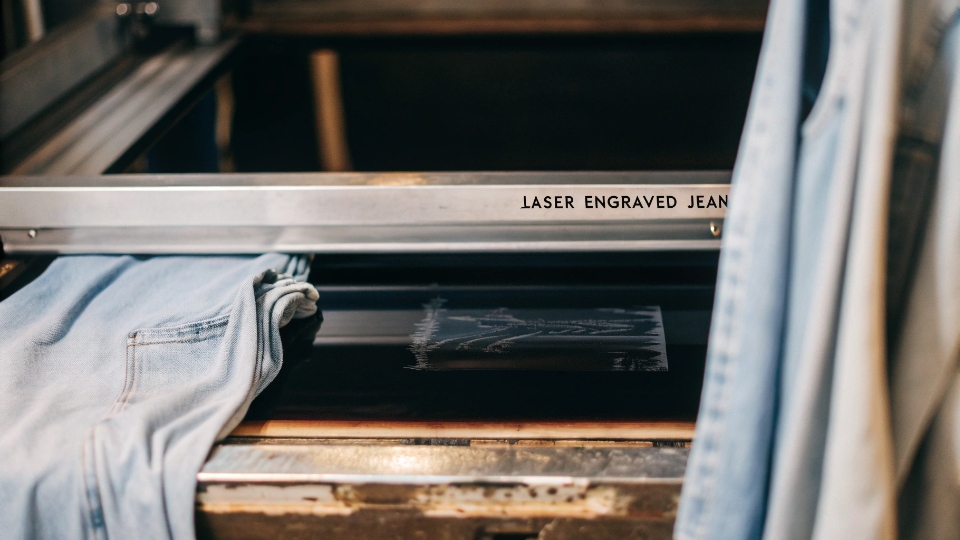
Think of it like a digital stencil. In the old days, we might have used physical masks to try and protect areas, but they were never perfect.
With a CO2 laser, the protection is completely digital and flawless. The design file we create is essentially a map that tells the laser beam's galvanometer mirrors where to direct the energy. The instructions are absolute: "fire" at this pixel, "off" at the next.
Because the beam's diameter is fractions of a millimeter, the transition from an engraved area to a non-engraved area is incredibly sharp. There is no "heat haze6" or thermal bleeding into the surrounding denim.
This precision allows for designs that were previously impossible, like placing a delicate, bright white graphic right next to a deep indigo seam without any crossover or smudging. The machine's precision is what protects your design's integrity.
Can I Review Test Scans Before Approval?
You cannot risk an entire production run based on a factory's verbal promise that "it looks good." You need to see the result on your actual fabric before you greenlight thousands of units.
Yes, this is a mandatory quality gate. We provide high-resolution photos7 and videos of the first test scan on a full garment for your review. We will not proceed until you give your final approval.
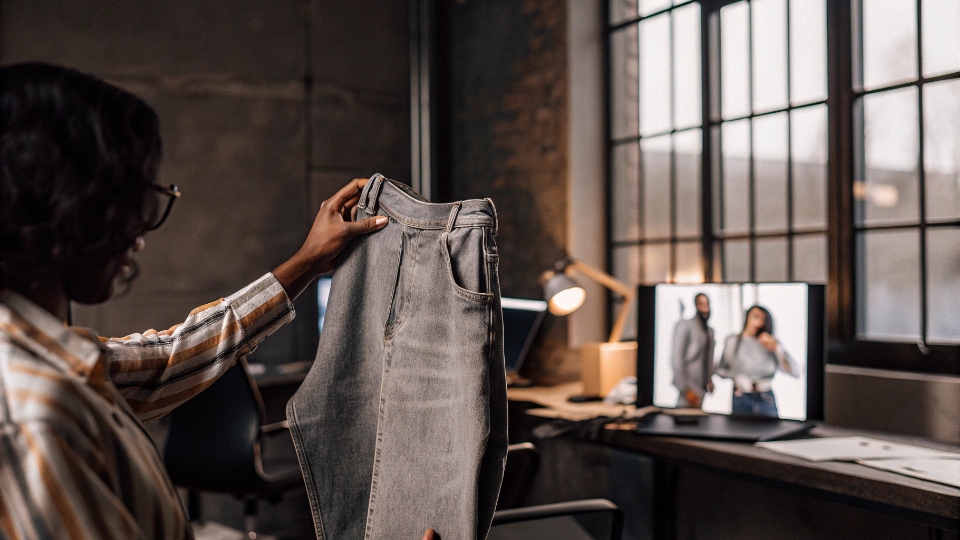
You are always in the driver's seat during the approval process. We make it collaborative and transparent. Once our technicians complete the machine calibration and are confident in the settings, we run the first full test scan on one of the actual production garments. We will then send you a complete digital review package.
This includes high-resolution photos of the garment laid flat to show the full pattern, close-up shots of detailed areas, and a short video to show how the effect looks as the fabric moves and drapes. This allows you to check for pattern accuracy, intensity, and placement.
If you need any adjustments, like making a whisker slightly lighter or moving a logo by 5mm, we will tweak the digital file and run another test scan for you. Bulk production using the laser only begins after we have your explicit email confirmation that the test scan is approved.
Conclusion
Laser technology offers incredible creative freedom with unmatched precision. Our expert calibration and strict approval process ensure we execute your vision perfectly, protecting both the fabric and your brand's reputation.
-
Explore how calibrated CO2 lasers ensure precision in engraving without damaging fabric. ↩
-
Learn about the process of creating digital design files for accurate laser engraving. ↩
-
Understand the dye sublimation process and its role in laser engraving on fabrics. ↩
-
Discover how a parameter matrix helps in achieving consistent results in laser engraving. ↩
-
Understand the concept of pixel-perfect accuracy and its importance in laser engraving. ↩
-
Learn about heat haze and how to prevent it for clean laser engraving results. ↩
-
Find out how high-resolution photos aid in the approval process for laser-engraved designs. ↩