
As a designer, you pour your creativity into every stitch, wash, and cut. So when you create something special, you naturally want to protect it from copycats. But can you just go out and get a patent for your new jean design? The answer is more complex than you might think.
You generally cannot patent a standard pair of jeans because they lack the required novelty.1 The basic five-pocket design has been a public "prior art" for over a century. However, you can patent specific, unique innovations, like a new fabric technology or a truly original ornamental design.
Protecting your creative work is one of the biggest challenges in the fashion industry. Every day at my factory, DiZNEW, I help designers like you, Dean, bring unique ideas to life. And a common question I get is, "How do I stop someone else from stealing this?" The truth is, you can't patent "a pair of jeans" as a whole category. But there are absolutely ways to protect your specific, brilliant innovations. To understand how, we have to look at what patents are for and how the legends of denim protected their own work.
Who owns the patent for jeans?
If you can't patent jeans now, did someone patent them in the beginning? The original story involves gold miners, a frustrated wife, and a clever tailor with an idea that changed fashion forever.
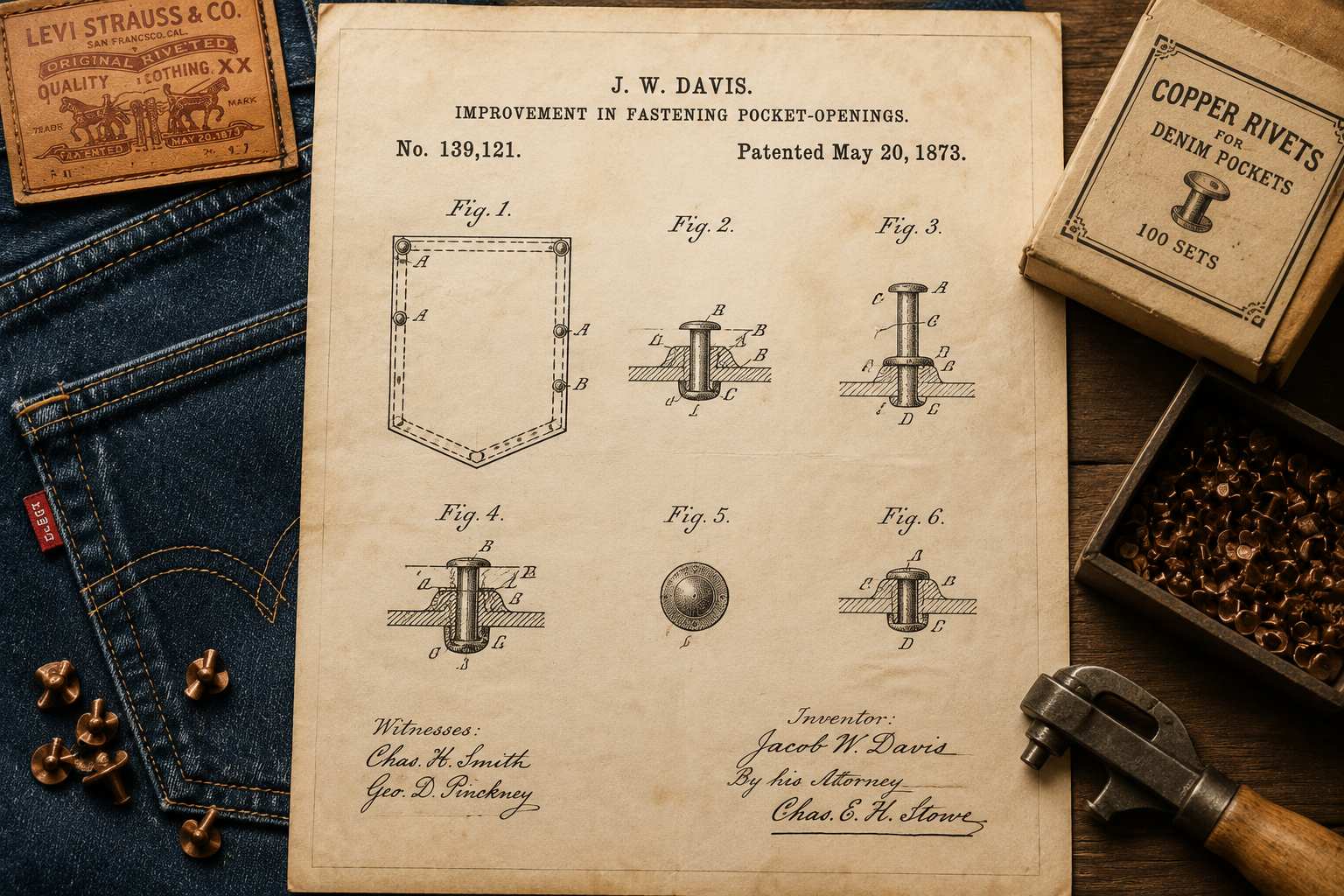
The first patent related to modern jeans was granted to tailor Jacob W. Davis and his supplier, Levi Strauss, on May 20, 1873.2 This patent wasn't for jeans themselves, but for an "Improvement in Fastening Pocket-Openings" using copper rivets to make them stronger.
Dive Deeper: Patenting an Idea, Not a Garment
This piece of history is the perfect illustration of what patents are for. Jacob Davis was a tailor in Reno, Nevada.3 His customers, mainly rugged laborers, constantly complained that their pant pockets were ripping out. Davis had a brilliant idea: he used the copper rivets from horse blankets to reinforce the corners of the pockets and other stress points. It worked perfectly. He wanted to patent his idea but didn't have the $68 filing fee. So, he wrote a letter to his fabric supplier, Levi Strauss, and proposed they go into business together.
They received U.S. Patent No. 139,121.4 The key here is that they patented a specific, functional invention—the process of using rivets on pants—not the pants themselves. It was a new, non-obvious solution to a common problem. Once that patent expired, any company was free to use rivets. This is when Levi's had to get creative with branding, using things like their Two Horse logo and red tab to stand out. It's a crucial lesson: protect your specific inventions, but build your brand to last.
What products cannot be patented?
You have a great idea, but is it actually patentable? Not everything is. Understanding the basic rules can save you an incredible amount of time, money, and frustration before you even start the process.
You generally cannot patent laws of nature, abstract ideas, or things that are already in the public domain and lack novelty. In fashion, this means you can't patent a basic garment type like "a shirt" or an obvious modification like changing a standard color.
Dive Deeper: The Rules of Invention
The patent system is designed to protect genuine inventions, not common knowledge. For something to be patentable, it generally has to meet three criteria: it must be novel, non-obvious, and useful. A standard five-pocket jean fails the first two tests spectacularly. It isn't novel (new) because it's existed for over 100 years. It also isn't non-obvious, because making a slight change to a jean's length or using a common wash technique is an obvious step for any designer.
Let's break it down for a designer like you, Dean. Think about it in a table format. Where does your idea fit?
| Item/Idea | Patentable? | Why? |
|---|---|---|
| A Standard Blue Jean | No | Lacks novelty and is obvious. It's public domain. |
| A New Self-Heating Fabric | Yes (Utility Patent) | It's a new, useful, and non-obvious invention. |
| A Truly Unique Jean Silhouette | Maybe (Design Patent) | If the overall shape is new and purely ornamental. |
| A Unique Artistic Print | No (Not with a patent) | This is protected by copyright, not patent law. |
| A Distinctive Pocket Stitch | No (Not with a patent) | But it can be protected as a trademark! |
This is why you can't just patent "jeans." But if you invent a new type of water-repellent denim, that's an
So if you can't get a patent on your cool new jean style, what about copyright? Can you use that to stop people from copying your design? This is where the protection strategy for fashion gets interesting.
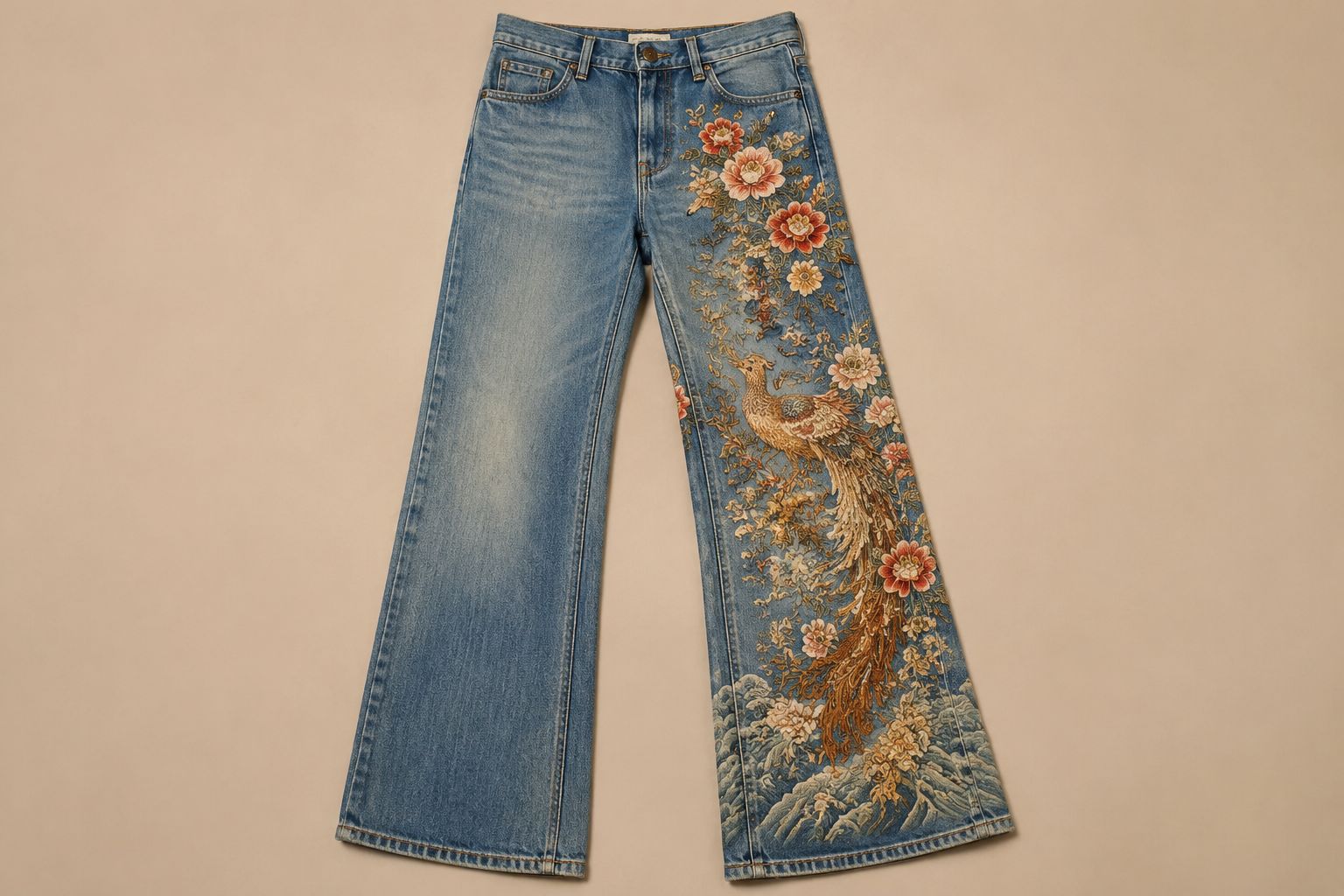
No, you cannot copyright the functional cut of a pair of jeans because it's a "useful article." However, you absolutely can copyright the original artistic elements on the jeans, such as a unique fabric print, an intricate embroidery pattern, or a graphic design.
Dive Deeper: The IP Toolkit for Designers
In the denim industry, we don't rely on just one tool. We use a combination of intellectual property rights to protect our work. As a designer, this is your creative toolkit.
First, there's Copyright. This protects your art. The beautiful floral pattern you designed to be printed on the denim? That's your art. The complex embroidery you sketched for the back pocket? That's your art. As soon as you create it, it's automatically copyrighted. It protects the visual expression, not the functional cut of the pants.
Second, there's Trademark. This is arguably the most powerful tool in fashion. It protects your brand identity. Think of the iconic arcuate stitching on the back of Levi's pockets or Lee's "Lazy S" stitch. Those are registered trademarks. You can't copy them because they tell the consumer who made the product. If you develop a unique hardware shape, stitch pattern, or logo and use it consistently, you can register it as a trademark to protect your brand's identity.
Finally, patents come back into play for true technical or design inventions. If your innovation is genuinely new and non-obvious, you should pursue it. But for most designers, the real power lies in combining copyright and trademark to create a legally protected and recognizable brand.
Conclusion
You can't patent a typical pair of jeans, but you can patent a true invention. Smart designers protect their work using a powerful mix of copyright for their art and trademarks for their brand.
-
"2141-Examination Guidelines for Determining ...", https://www.uspto.gov/web/offices/pac/mpep/s2141.html. USPTO guidance explains that patentable inventions must satisfy novelty and non-obviousness requirements, which supports the general statement that a conventional, already-known garment form is not patentable as such. Evidence role: expert_consensus; source type: government. Supports: A standard pair of jeans generally cannot be patented because it lacks novelty.. Scope note: This supports the legal principle rather than assessing any particular jeans design. ↩
-
"Forever in Blue Jeans…and in Court - Pieces of History", https://prologue.blogs.archives.gov/2010/05/20/forever-in-blue-jeansand-in-court/. The patent record for U.S. Patent No. 139,121 identifies Jacob W. Davis and Levi Strauss as patentees and gives the issue date as May 20, 1873, supporting the historical patent attribution. Evidence role: case_reference; source type: government. Supports: Jacob W. Davis and Levi Strauss received a patent related to modern jeans on May 20, 1873.. Scope note: The record establishes the patent details, not that it was definitively the first patent related to every aspect of modern jeans. ↩
-
"Jacob W. Davis", https://en.wikipedia.org/wiki/Jacob_W._Davis. Historical accounts of the Davis-Strauss patent identify Jacob W. Davis as a Reno, Nevada tailor, supporting the biographical context of the invention. Evidence role: historical_context; source type: institution. Supports: Jacob Davis was a tailor based in Reno, Nevada.. Scope note: Such accounts summarize historical records and may not independently verify every detail of Davis’s shop operations. ↩
-
"Forever in Blue Jeans…and in Court - Pieces of History", https://prologue.blogs.archives.gov/2010/05/20/forever-in-blue-jeansand-in-court/. The official patent record lists U.S. Patent No. 139,121 as issued to Jacob W. Davis and Levi Strauss for fastening pocket openings, confirming the patent number cited in the article. Evidence role: case_reference; source type: government. Supports: Davis and Strauss received U.S. Patent No. 139,121.. ↩