Skip to content

You’re an expert designer, but clearly explaining the subtle yet critical differences between core fits can be challenging. Your team needs to understand that straight and skinny are not just styles, but different engineering philosophies.
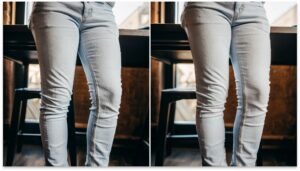
The main difference is the leg silhouette. A straight-leg jean falls straight from the thigh to the ankle, while a skinny jean tapers aggressively from the knee down to a narrow leg opening.

Dean, when we get a tech pack for a straight-leg versus a skinny jean, we are looking at two completely different sets of rules. Your insight about skinny jeans having extra "slack" at the top is something we see in pattern-making every day.
A skinny jean is engineered around stretch fabric. It has to be. The pattern is cut to hug the body, but it needs that give in the seat and thighs to allow for movement before it tapers down.
A straight-leg jean is pure geometry. It’s a column. It's often designed for rigid, 100% cotton denim and relies on the cut for comfort, not the fabric's elasticity.
Are Straight-Leg Jeans the Same as Skinny Jeans?
The fit through the thigh can sometimes feel similar. This leads people to mistakenly believe the two styles are just slight variations of each other, causing confusion during design hand-offs.
No, they are fundamentally different. A straight-leg jean maintains a consistent width from the knee to the ankle, while a skinny jean becomes significantly narrower, creating two distinct silhouettes and requiring different fabrics.

From a manufacturing standpoint, these two fits could not be more different. We treat them as separate categories entirely. The entire process, from fabric selection to the final stitch, is guided by the specific goal of the silhouette.
A skinny jean is all about creating a second-skin effect, which is impossible without incorporating stretch fibers like elastane. A classic straight-leg is about creating a clean, architectural line, which works best with sturdy, non-stretch denim.
Thinking they are similar is a common mistake, but on the factory floor, they represent two opposite ends of the denim spectrum. The only thing they truly share is the basic five-pocket construction.
The Manufacturer's View: Straight vs. Skinny
| Feature | Straight-Leg Jeans | Skinny Jeans |
|---|---|---|
| Pattern Shape | The leg pattern is cut almost straight down from the thigh. Knee and leg opening measurements are very close. | The pattern curves inward dramatically from the knee to the ankle. The leg opening is the narrowest point. |
| Primary Fabric | Traditionally 100% cotton rigid denim. Some modern versions have minimal "comfort stretch." | High-stretch denim is required (typically 2% or more elastane). |
| Fit Philosophy | To create a clean, uniform line that skims the body. It's about structure. | To contour and cling to the body's natural shape. It's about highlighting form. |
| Key Measurement | The leg opening is wide enough to fit over boots, reflecting its workwear origins. | The leg opening is very narrow, designed to stack at the ankle or be cuffed tightly. |
What Body Type Do Straight-Leg Jeans Look Good On?
You want to design a core style for your collection that has the broadest appeal. You need to know which fit works for the widest range of customers without alienating any specific body type.
Straight-leg jeans are famously versatile and look good on almost every body type. They are particularly flattering on athletic and larger builds, as they balance proportions without clinging or adding visual bulk.

When a new brand comes to me and wants to create their first "hero" product, I almost always recommend starting with a straight-leg jean. The reason is simple: it is the most democratic fit in denim.
From a pattern-making perspective, its success lies in what it doesn't do. It doesn't constrict the thighs, which is great for athletic builds. It doesn't taper aggressively, which avoids creating an unbalanced "ice-cream cone" look on larger frames.
Instead, it creates a clean, uninterrupted line from the hip to the hem. This has an elongating and balancing effect. For slimmer guys, it adds a bit of classic structure without overwhelming their frame.
It's the one fit that you can recommend to almost anyone with confidence, knowing it will provide a solid, flattering foundation.
What Does "Straight-Leg" Mean on Jeans?
Your technical team needs a precise definition to execute patterns correctly. The term "straight" can be interpreted in different ways, leading to costly mistakes in sampling and production.
"Straight-leg" is a technical pattern-making term. It means the width of the jean leg remains uniform from the knee down to the leg opening, creating a straight vertical line.

On the cutting table, "straight-leg" is all about the numbers. When we look at a tech pack for a straight-leg fit, we are checking two key measurements: the knee and the leg opening.
In a true straight cut, these two numbers will be identical or very close to it. For example, a size 32 waist might have a 17-inch knee and a 17-inch leg opening.
The jean may taper slightly from the thigh to the knee, but from that point down, it's a perfect column. This simple geometry is the entire essence of the fit.
It’s a definition rooted in the history of workwear, where this cut was practical, easy to produce, and fit over work boots. It is the original blueprint for a pair of jeans.
Who Should Wear Straight-Fit Jeans?
Your marketing team is asking for guidance on how to position this style. You need to define the target customer for a straight-fit jean to build a clear and effective brand message.
Anyone seeking a timeless, comfortable, and versatile jean should wear a straight fit. It’s ideal for men who prioritize classic style over fleeting trends and value a fit that works for any occasion.

The man who chooses a straight-fit jean is making a deliberate choice for timelessness. He's not chasing the latest super-tight or super-baggy trend.
He wants a pair of jeans that looks as good today as it will in five years. In the factory, we see this as the "workhorse" fit. It's the style we produce consistently, year after year, regardless of what's happening on the runway. This customer can be a creative professional, a weekend warrior, or a guy who just wants one great pair of jeans that he doesn't have to think about.
He values comfort that comes from a good cut, not from synthetic stretch. He wants a jean that can be dressed up with a blazer or down with a hoodie. The straight fit is the foundation of a man's wardrobe.
Conclusion
The difference between straight and skinny is a story of structure versus stretch. Straight-leg jeans offer timeless, geometric lines for versatility, while skinny jeans use elasticity to provide a modern, body-contouring fit.