
You've got a perfect vision for a custom color, but the garment dye sample comes back blotchy and uneven. It's a frustrating setback. I'll explain the hidden reasons in denim that reject new color.
Certain jeans resist dye due to their material, original dyeing process, and chemical treatments. Synthetic blends like polyester and spandex, waterproof coatings, and residual fixatives from the original color can all block new dye from bonding with the cotton fibers.1
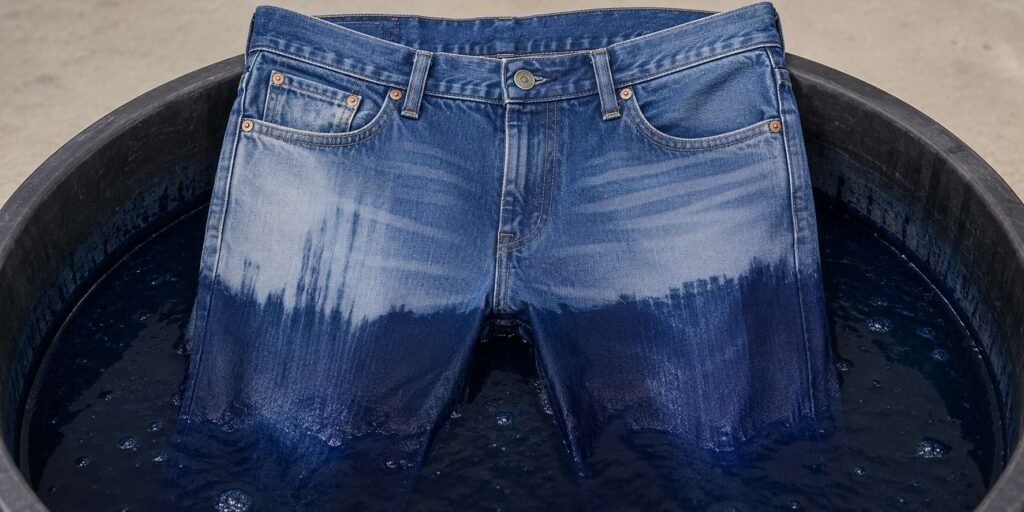
From my perspective as a manufacturer, dyeing is a science of compatibility. When a designer like you wants to over-dye a finished garment, we're not starting with a blank canvas. We're working with a material that has a history—a history written in its fibers, its original color, and its finish. Understanding that history is the key to predictable, successful dyeing. Let's break down the factors that can make or break your custom color project.
Will Rit all purpose dye denim?
You need a quick color test and reach for a common dye. But using a home product on professional denim is a huge gamble. I'll explain why it's so unpredictable.
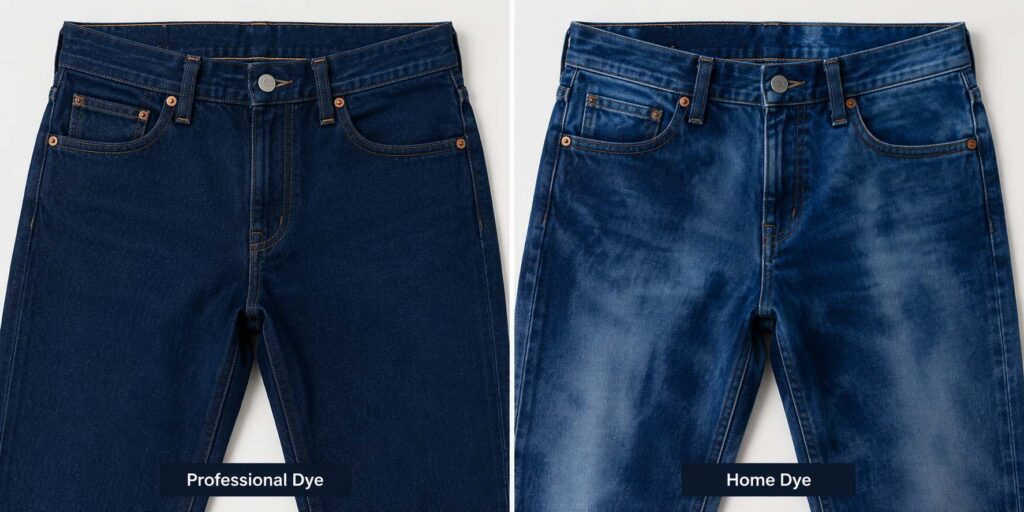
Yes, Rit dye can color denim, but the results are a toss-up.2 It works best on 100% cotton jeans but will struggle on modern stretch blends containing polyester or spandex. It cannot replicate the depth, evenness, or colorfastness of a professional industrial dye job.3
Dive Deeper: Why Home Dyes Fail on Pro Denim
For a designer, a quick sample is essential, but using a home dye like Rit can give you a false result. The reason lies in the industrial nature of modern jeans. First, most jeans now contain synthetic fibers like spandex or polyester for stretch. Rit's all-purpose dye is designed for natural fibers like cotton; it simply won't stick to the plastic-based synthetics.4 This immediately results in an uneven, heathered look.
Second, many jeans have invisible chemical coatings. Softeners, anti-wrinkle finishes, or water-resistant treatments act like a raincoat, preventing dye from ever reaching the fiber. Third, the original dye can cause problems. Jeans are yarn-dyed, meaning the original indigo only coats the outside of the yarn. A strong chemical fixative is often used to lock in that color. A home dye isn't strong enough to break through these barriers and can react unpredictably with them, creating a completely different color than you intended. True garment dyeing requires stripping these barriers and using industrial-grade chemistry.
| Challenge | Home Dyeing (Rit) | Industrial Dyeing (DiZNEW) |
|---|---|---|
| Synthetic Blends | Fails to color synthetics, leading to splotchy results. | Uses specific dyes and carriers for each fiber type. |
| Chemical Coatings | Blocked by invisible finishes, causing uneven dyeing. | Uses scouring agents to strip coatings before dyeing. |
| Original Dye | Reacts unpredictably with fixatives and indigo. | Controls chemical reactions for predictable outcomes. |
Why does Gen Z hate skinny jeans?
You're seeing a major shift in silhouettes away from skin-tight fits. This change in taste seems sudden and dramatic. I'll explain the mindset and how it impacts our craft.
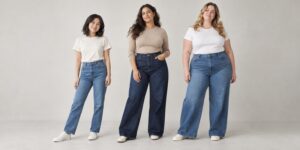
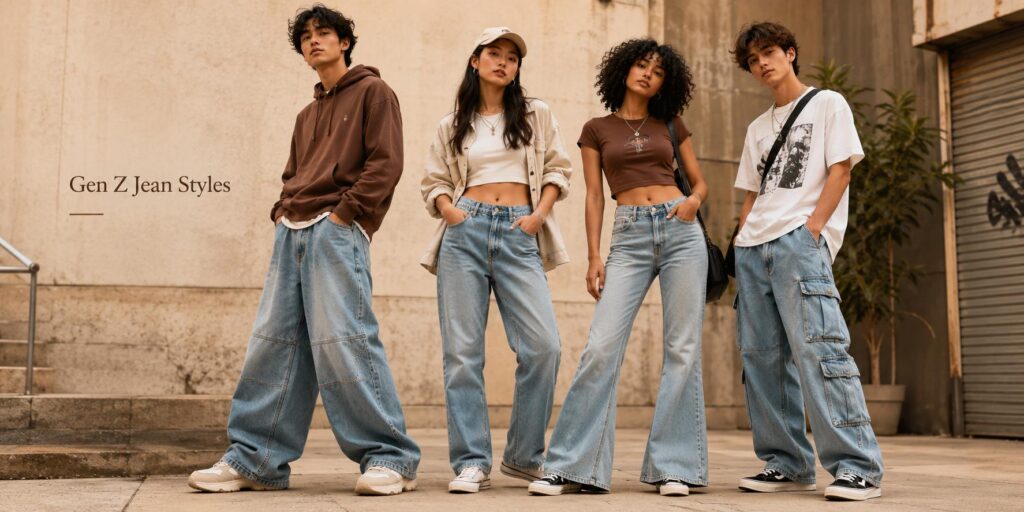
Gen Z doesn't universally "hate" skinny jeans; their preference has just shifted to comfort, individuality, and looser fits.5 Baggy, straight, and flare styles offer a more relaxed aesthetic and a different canvas for self-expression, moving away from the body-conscious look of the 2010s.
Dive Deeper: From Silhouette to Finishing
This shift in trend has real consequences for us in production, especially when it comes to dyeing and washing. A skinny jean and a baggy jean are two completely different canvases. A skinny jean is defined by its stretch and how it hugs the body. The high-stress areas at the knees and thighs will show wear and fading patterns very differently. Any dye effect has to account for this constant stretch.
In contrast, a '90s-style baggy jean has large, flat panels of fabric. This opens up huge opportunities for bold, all-over dye treatments, large-scale laser patterns, or a clean, uniform wash. The fabric drapes and hangs rather than stretches. As a designer, you can think in bigger gestures. For my team, it means we adjust our techniques. The way we apply a spray-on fade or place a laser pattern on a baggy leg is completely different from how we would do it to follow the contours of a skinny leg. The silhouette dictates the finish.
| Jean Fit | Design Considerations for Dye/Wash | Manufacturing Approach |
|---|---|---|
| Skinny Fit | Focus on high-stretch areas, potential for "cracking" effects. | Precise, contoured application of washes; must test on a 3D leg form. |
| Baggy Fit | Large canvas for bold prints, even color, or dramatic all-over effects. | Can treat fabric as a flatter surface; allows for bigger, more graphic treatments. |
What jeans cost $10,000?
You hear about jeans with an astronomical price tag and it sounds absurd. What could possibly make a pair of pants worth that much? I'll break down the world of couture denim.
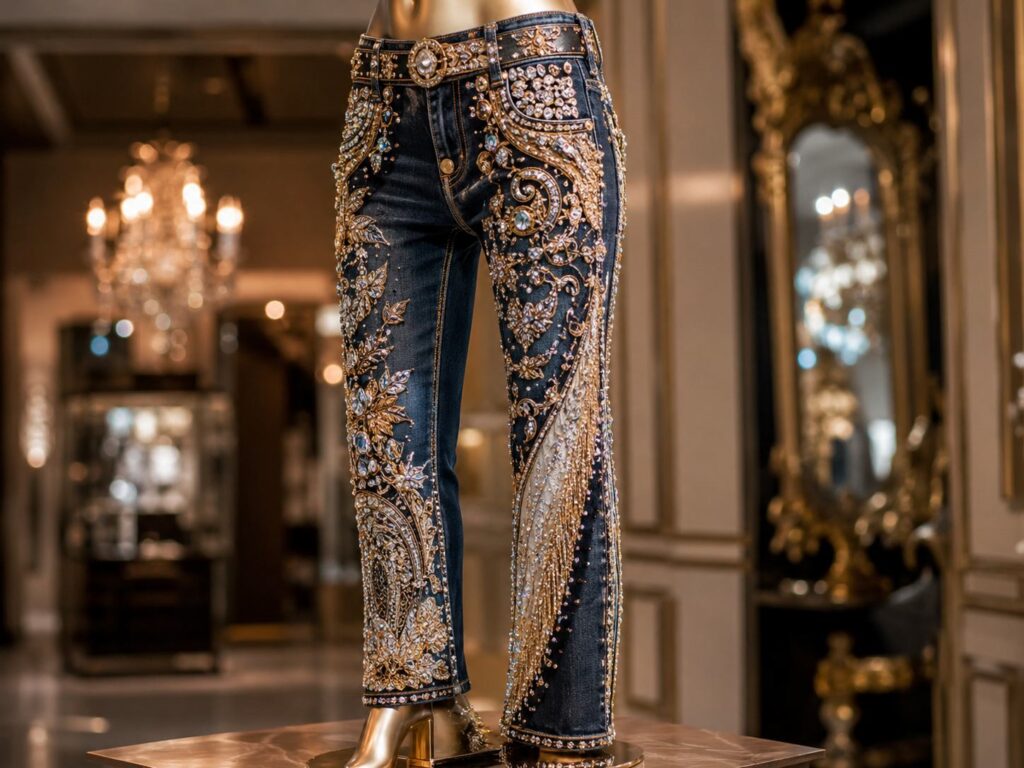
Jeans that cost $10,000 are haute couture art pieces. The price comes from extreme customization, rare materials, intricate hand-done labor like embroidery or embellishments, and powerful brand exclusivity. These aren't just clothes; they are wearable collectibles.
Dive Deeper: The Anatomy of a Five-Figure Jean
When you get to this price point, you leave the world of apparel and enter the world of luxury goods. Several factors create this value. First is the material. We're talking about small-batch Japanese selvedge denim, maybe even woven with precious metal threads. The hardware might be sterling silver or custom-molded. Then comes the labor. These jeans are touched by dozens of artisans. Think hours of hand-distressing to create the perfect wear pattern or intricate hand-embroidery that takes days to complete.
Most importantly for us, the dye and wash process is entirely bespoke. A $10,000 pair might be hand-painted by an artist, or go through a dozen different steps of dyeing and bleaching to achieve a one-of-a-kind color profile. From my factory's perspective, this is our highest art form. We might develop a unique enzyme wash or use natural pigments from a rare plant. The goal isn't just to make a pair of jeans; it's to create an object that is completely unique. That uniqueness, backed by a famous brand name, is what commands the price.
| Feature | Mass-Market Jean ($100) | Couture Jean ($10,000) |
|---|---|---|
| Material | Standard open-end denim, cotton/poly/spandex blend. | Rare Japanese selvedge, unique fiber blends. |
| Hardware | Basic zamak buttons and copper rivets. | Sterling silver, custom designs, precious stones. |
| Dye/Wash | Automated, large-batch process. | Multi-step, hand-done, bespoke process. |
| Exclusivity | Millions of units produced. | Limited edition, often 1-of-1. |
What is the 2 finger rule for jeans?
You've perfected the design, but the final feedback is about comfort. a simple, old-school trick that cuts right to the heart of a good fit.
The two-finger rule is a quick test for the waistband's fit.6 You should be able to slide two fingers snugly between your waist and the waistband. It confirms the jeans aren't too tight and have enough ease for comfortable movement.
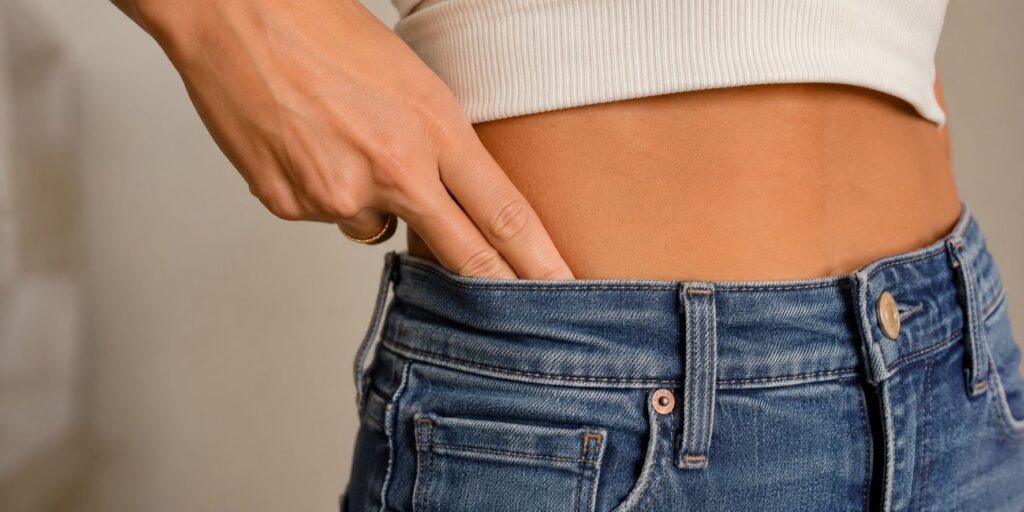
Dive Deeper: Why Fit is Critical for the Finish
The two-finger rule is more than a customer's trick; it's a guide to how your design will last. For a designer, this little bit of 'ease' is crucial for the intended look and feel. But for a manufacturer, it also impacts the longevity of the wash and dye.
Think about it. When a pair of jeans is too tight, the fabric is under constant tension. The cotton fibers are stretched to their limit. This puts incredible stress on the surface finish. The beautiful dye color you chose will abrade and wear away much faster at the high-stress points like the hips and waistband. Any special wash effects, like light whiskering, will be distorted or disappear as the fabric is pulled taut. A proper fit, with that little bit of two-finger ease, allows the fabric to sit as intended. This means the wash, the color, and the distressing we worked so hard to perfect will age gracefully and look good for far longer. Fit isn't just about comfort; it's about preserving the integrity of the finish.
Conclusion
Successful dyeing is about more than just color. It requires a deep understanding of fabric, chemistry, and fit to transform a vision into a perfectly executed, lasting garment. It’s a partnership.
-
"Advancements in Sustainable Natural Dyes for Textile Applications", https://pmc.ncbi.nlm.nih.gov/articles/PMC10458907/. Textile dyeing literature describes dye uptake as dependent on fiber chemistry and surface treatments, and notes that polyester, elastane-containing blends, repellency finishes, and dye-fixation processes can alter or inhibit subsequent dye adsorption; this supports the general mechanism rather than proving every denim garment will resist overdyeing. Evidence role: mechanism; source type: paper. Supports: Synthetic blends, waterproof coatings, and residual fixatives can prevent new dye from bonding evenly with denim fibers.. Scope note: Support is contextual because dye resistance varies by fiber percentage, finish chemistry, dye class, and process conditions. ↩
-
"[PDF] Dyeing and Colorfastness in Fabrics - Oregon State University", https://ir.library.oregonstate.edu/downloads/pc289j22n. General dyeing references explain that cotton denim can be dyed with direct or all-purpose dyes, but shade levelness and fastness depend on fiber composition, pretreatment, dye class, temperature, and agitation; this supports the unpredictability of home overdyeing as a process-level concern rather than evaluating a specific brand formulation. Evidence role: general_support; source type: education. Supports: All-purpose home dye can color cotton denim, but results may be inconsistent depending on textile and process variables.. Scope note: The source may not test Rit specifically, so it should be used to support the broader dyeing principle rather than brand-specific performance. ↩
-
"Advancements in Sustainable Natural Dyes for Textile Applications", https://pmc.ncbi.nlm.nih.gov/articles/PMC10458907/. Industrial textile dyeing sources identify controlled pretreatment, dye selection, liquor ratio, temperature, pH, and washing-off as determinants of shade depth, levelness, and colorfastness, supporting the comparison that controlled industrial dyeing can achieve more reproducible results than informal home processes. Evidence role: mechanism; source type: paper. Supports: Home all-purpose dyeing generally cannot match the depth, evenness, and colorfastness achievable through controlled industrial denim dyeing.. Scope note: The source would support the process advantage of industrial dyeing, not a universal ranking of every home-dyed garment against every factory-dyed garment. ↩
-
"One-bath one-dye class dyeing of polyester/cotton blend fabric with ...", https://ui.adsabs.harvard.edu/abs/2022DiMat...2...14T/abstract. Textile dyeing references state that hydrophobic synthetic fibers such as polyester require dye classes and process conditions different from those used for cellulosic fibers such as cotton, supporting the mechanism that a cotton-suitable all-purpose dye may not adequately color synthetic components. Evidence role: mechanism; source type: education. Supports: All-purpose dyes intended for natural fibers do not reliably bond to synthetic fibers such as polyester or spandex.. Scope note: This supports the fiber-compatibility principle; it should not be read as a chemical analysis of Rit’s proprietary formulation. ↩
-
"Gen Z + Denim - Cotton Incorporated Lifestyle Monitor™", https://lifestylemonitor.cottoninc.com/gen-z-denim/. Market and sociological reporting on youth fashion trends documents a movement among younger consumers toward looser denim silhouettes and comfort-oriented apparel after the dominance of skinny jeans; this supports the trend context, while individual preferences within Gen Z remain heterogeneous. Evidence role: historical_context; source type: institution. Supports: Gen Z denim preferences have shifted toward comfort, individuality, and looser silhouettes rather than universally rejecting skinny jeans.. Scope note: Trend evidence is population-level and time-sensitive, so it cannot establish the preference of all Gen Z consumers. ↩
-
"Pressing Pointers - BE BOLD. Shape the Future.", https://pubs.nmsu.edu/_c/C309/index.html. Consumer apparel fit guides commonly describe inserting two fingers at the waistband as a practical check for adequate ease, supporting the rule as an informal fit heuristic rather than a formal sizing standard. Evidence role: definition; source type: institution. Supports: The two-finger rule is an informal method for checking whether a jeans waistband has comfortable ease.. Scope note: This is a rule of thumb and may not be validated by ergonomic testing or applicable to every body shape, rise, or denim fabric. ↩