

Confused by the trend of low-slung jeans that seem to defy gravity? It’s a look that often courts controversy. I'm here to unpack the deep cultural roots behind this enduring style.
People wear their jeans low, a style known as "sagging,"1 as a statement of rebellion and cultural identity. Originating in US prisons and popularized by hip-hop2, it represents a rejection of mainstream norms and has evolved into a powerful fashion symbol.

I've been making jeans for over twenty years, and I've seen styles come, go, and come back again. Sagging is one of the most interesting because it wasn't born on a fashion runway. It started in a place you'd never expect and became a global phenomenon. For a designer like you, understanding the "why" behind a trend like this is crucial. It’s not just about a fit; it’s about a story. Let's explore the history behind wearing jeans low.
Why do people wear their jeans so low?
You see it on the street and wonder about the origin. It’s a look that's often misunderstood. I'll trace its surprising journey from a place of restriction to a symbol of freedom.
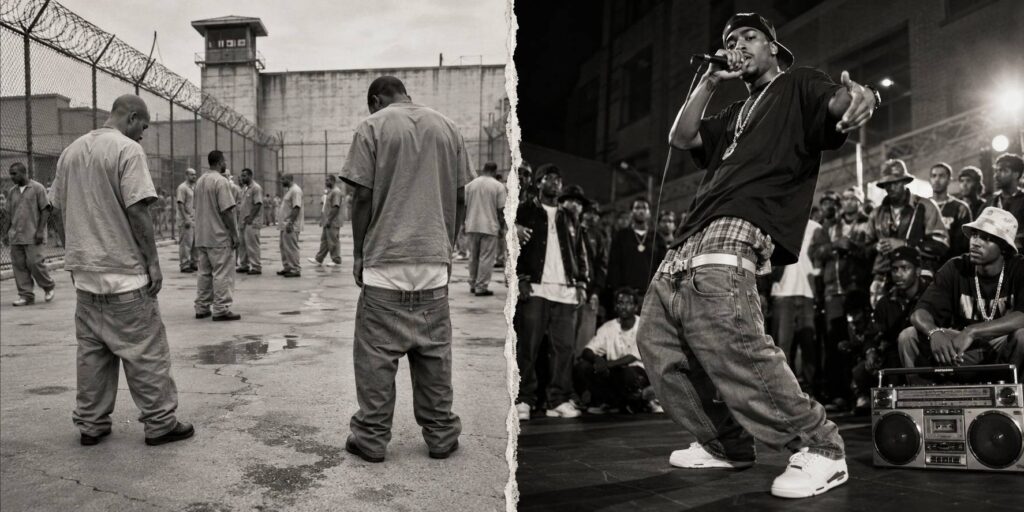
People wear jeans low as a form of rebellion. This style, called sagging, originated in US prisons where belts were banned. It was later adopted by hip-hop culture as a defiant statement against authority and a way to express a non-conformist attitude.
Dive Deeper: From Prison Uniform to Cultural Statement
The story of sagging pants doesn't start in a designer's studio. It starts in the American prison system. For safety reasons, inmates were often not allowed to have belts. As a result, their loose-fitting, oversized uniforms would naturally sag down. This unintentional style was carried outside the prison walls and became a symbol. For young people, it was a way to challenge societal rules and authority.
Hip-hop culture was the rocket fuel for this trend. In the 90s, influential artists in rap and street dance embraced the look3. It perfectly matched the culture's emphasis on individuality and freedom from the norm. The style spread like wildfire, moving from a subculture statement to a mainstream trend. As a manufacturer, it’s fascinating. We make the jeans, but culture gives them their meaning. Sagging transformed a simple pair of pants into a powerful symbol of identity.
| Origin | Cultural Movement | Symbolism |
|---|---|---|
| US Prisons | Inmates without belts | A practical reality born from restriction. |
| Street Culture | Youth adoption | A visual challenge to authority and social rules. |
| Hip-Hop Culture | Mainstream popularization | A statement of authenticity, freedom, and rebellion. |
What is the point of low-rise jeans?
Low-rise jeans are very different from sagging, but they also sit low. What's their purpose in fashion? Let's clarify the intent behind this specific cut.
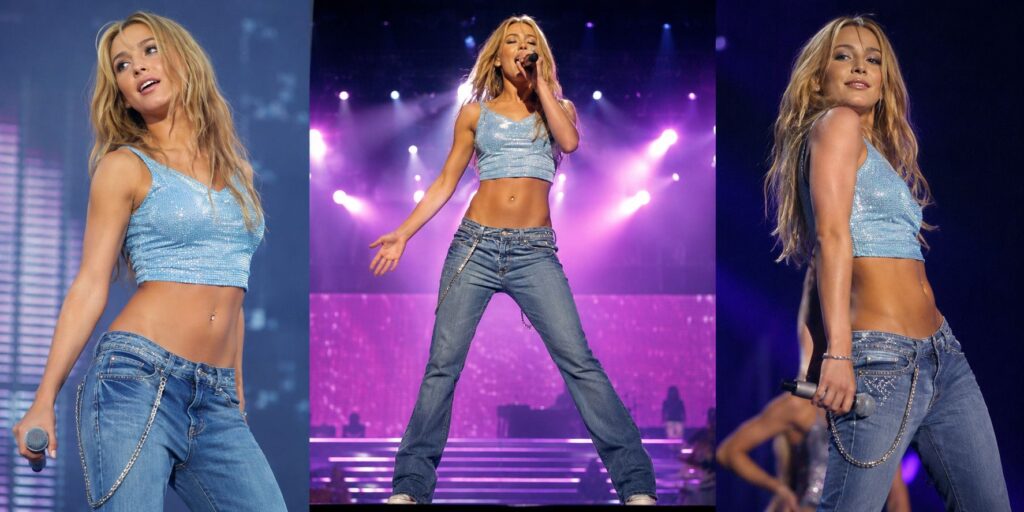
The point of low-rise jeans is to create a specific fashion silhouette that elongates the torso and showcases the hips and midriff4. Popularized in the Y2K era5, it’s a deliberate design choice for a confident, body-conscious aesthetic.
Dive Deeper: Sagging vs. Low-Rise
It's important for a designer to know the difference here. Sagging is a way of wearing any pair of jeans, usually baggy ones. Low-rise is a specific cut of jeans. While both sit low on the body, their intentions are completely different. Sagging comes from a place of cultural rebellion. Low-rise comes from pure fashion. During the early 2000s, fashion was all about the exposed midriff. Low-rise jeans were engineered perfectly for this look.
Today, high-fashion brands like Miu Miu and Jacquemus are bringing the low-rise back. This new wave is less about overt rebellion and more about a calculated, runway-approved nostalgia. From my factory's perspective, the two styles require very different work. A baggy jean for sagging needs the right drape. A low-rise jean needs meticulous patterning around the hips to fit perfectly without gaping. One is about attitude, the other is about anatomy.
Why does Gen Z not like skinny jeans?
For a decade, skinny jeans were king. Now, the new generation wants something different. This sudden shift can be confusing, but it makes perfect sense.
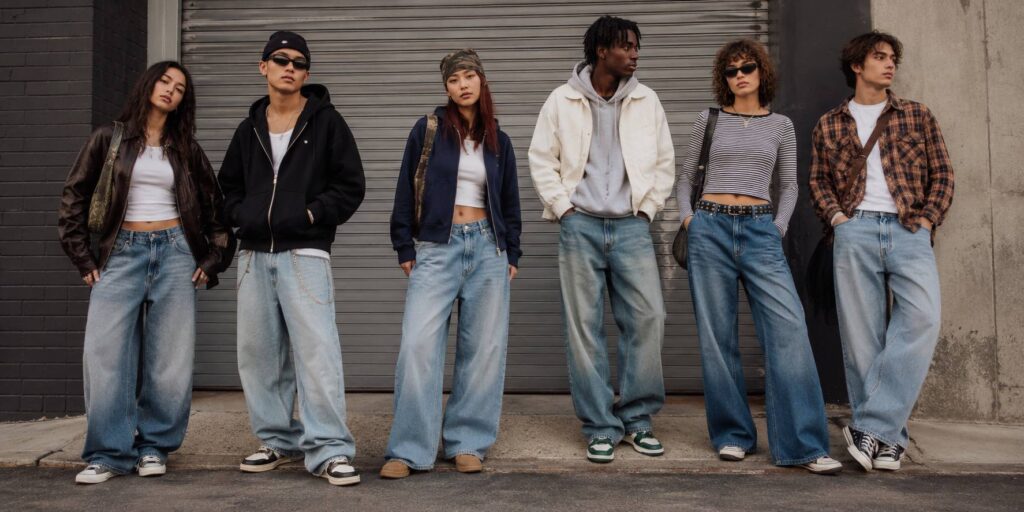
Gen Z's style has moved away from the tight-fitting skinny jean toward comfort and individuality. Looser fits like baggy, straight, and flare jeans offer more freedom and a relaxed look that aligns with their apathetic, laid-back aesthetic.
Dive Deeper: The Comfort Revolution
This change isn't just about fashion; it's a cultural shift. Millennials grew up with skinny jeans as the dominant style. Gen Z, on the other hand, grew up with the internet, where they were exposed to countless subcultures like skate culture and 90s revivalism, all of which favored looser clothing. This preference for baggy fits is part of a larger movement toward comfort that we see in athleisure.
For a designer, looser silhouettes offer a completely different canvas. A skinny jean is all about hugging the body's form. A baggy jean is about creating a shape with the fabric itself. As a manufacturer, this means our job changes. We're not just adding more fabric. We focus intensely on the drape and structure of the denim so that a baggy jean looks intentionally oversized, not just sloppy. It's a new kind of precision. The relaxed fit is the new uniform for a generation that values comfort as a form of luxury.
What does sagging mean in Gen Z?
You see younger people sagging their jeans today. Is it the same rebellious statement as it was in the '90s? The meaning has evolved with the new generation.
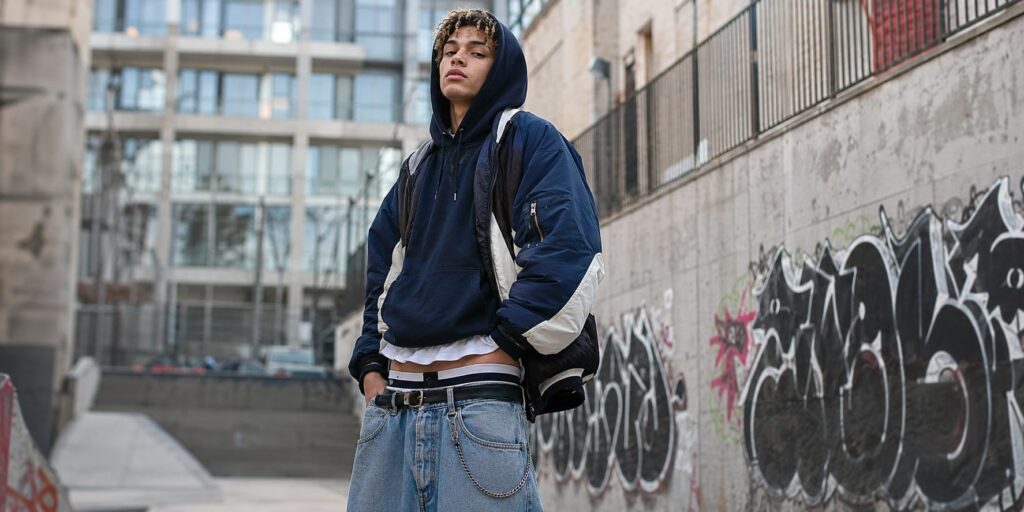
For Gen Z, sagging is more of a fashion choice inspired by 90s and Y2K nostalgia and skate culture. It’s less of a direct political statement and more a part of a relaxed, layered aesthetic that signals being part of a style tribe.
Dive Deeper: A New Generation's Interpretation
While the original rebellious roots are there, the primary meaning of sagging has shifted for many in Gen Z. It's become part of a stylistic uniform, heavily influenced by the mainstream adoption of skate culture. Skaters have always worn looser, lower pants for freedom of movement6, and this practical choice became an iconic look.
Today, sagging is also about layering and branding. The visible waistband of a specific brand of boxers is now a key part of the outfit. It’s a deliberate nod to 90s hip-hop fashion, re-contextualized for today. It’s a form of visual communication. By sagging their jeans, they are signaling their connection to a certain aesthetic that values nostalgia, comfort, and a casual attitude. The statement is still there, but it’s less about direct confrontation and more about belonging to a global style community.
Conclusion
Whether it's the cultural rebellion of sagging or the fashion-forward cut of low-rise, wearing jeans low is a powerful form of expression. It tells a story of an era, a culture, and a generation.
-
"Sagging - Wikipedia", https://en.wikipedia.org/wiki/Sagging. A reference source defines sagging as the wearing of trousers below the waist, supporting the article’s use of the term for low-worn jeans. Evidence role: definition; source type: encyclopedia. Supports: The low-worn jeans style described in the article is commonly called sagging.. ↩
-
"[PDF] The Constitutional Challenge to "Saggy" Pants Laws - BrooklynWorks", https://brooklynworks.brooklaw.edu/cgi/viewcontent.cgi?article=1258&context=blr. A scholarly or institutional account of hip-hop fashion identifies sagging or low-slung baggy pants as a style disseminated through rap and hip-hop culture in the late twentieth century. Evidence role: historical_context; source type: paper. Supports: Hip-hop culture helped popularize sagging pants.. Scope note: Such a source may show hip-hop’s role in popularization rather than prove it was the sole cause of mainstream adoption. ↩
-
"Fresh, Fly, and Fabulous: Fifty Years of Hip Hop Style", https://www.fitnyc.edu/museum/exhibitions/hip-hop-style/index.php. A history of hip-hop fashion or archived cultural coverage documents that prominent rap and dance performers wore baggy, low-slung trousers, supporting the claim that performers helped normalize the look. Evidence role: case_reference; source type: research. Supports: Rap and street-dance artists adopted low-slung or sagging pants in the 1990s.. Scope note: Examples of artists adopting the style illustrate influence but do not alone measure total causal impact on public fashion trends. ↩
-
"Low-rise (fashion)", https://en.wikipedia.org/wiki/Low-rise_(fashion). A fashion-design or costume-history source describing low-rise trousers as sitting below the natural waist supports the claim that the cut emphasizes the hips and exposed midriff in the wearer’s silhouette. Evidence role: definition; source type: education. Supports: Low-rise jeans are designed to sit below the waist and emphasize the hips and midriff.. Scope note: The source can support the design effect generally, but perceived body proportions depend on styling and individual anatomy. ↩
-
"Low-Rise Jeans - kaonohis", https://wordpress.business.oregonstate.edu/kaonohis/product-3/. A fashion-history source identifying low-rise jeans as a prominent early-2000s or Y2K trend supports the article’s dating of the style’s popularization. Evidence role: historical_context; source type: institution. Supports: Low-rise jeans were popularized during the Y2K or early-2000s fashion period.. Scope note: The source may document peak visibility in the period rather than the first appearance of low-rise cuts. ↩
-
"[PDF] Performance Apparel for Recreational Skate Skiing Males Aged 50 ...", https://scholarsbank.uoregon.edu/server/api/core/bitstreams/ca691b1b-5902-4793-a3cd-c5dde6274a6a/content. A history of skateboarding apparel or sports-culture study explaining the functional preference for loose clothing in skateboarding supports the link between skate practice and looser, lower pants. Evidence role: mechanism; source type: paper. Supports: Skate culture has commonly favored looser pants partly for movement and practicality.. Scope note: The word “always” is stronger than most historical sources can prove; evidence is likely to support a recurring or common tendency rather than an unbroken universal practice. ↩