
Frustrated when you grab your usual size, but it doesn't fit? This inconsistency is a major headache for shoppers and designers alike. I'm here to explain the hidden reasons behind it.
Sizing differs due to manufacturing tolerances, varying brand standards, and Post-wash fabric changes[^1]. A brand with its own factory has tight control over these factors, unlike a brand sourcing from multiple suppliers. This control is the key to delivering a consistent fit every single time.
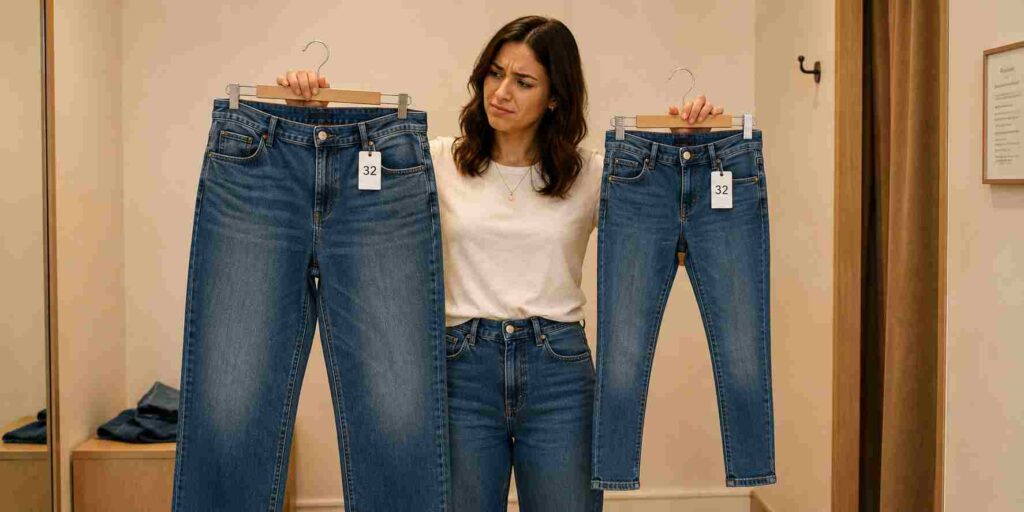
This isn't just a simple numbers game. The difference between a size 32 that fits and one that doesn't is a story about the entire production process. For you as a designer, and for me as a manufacturer, understanding these details is everything. It's what separates a professional brand from the rest. Let's break down exactly where these frustrating inconsistencies come from.
Are size 34 jeans actually 34 inches?
You designed jeans with a 34-inch waist, but the sample measures 35.5. This kind of infuriating mismatch wastes time and money. I'll explain what that "34" on the tag really means.
No, a "size 34" jean rarely measures exactly 34 inches at the waistband[^2]. Most brands use vanity sizing, meaning the actual garment measures 1-2 inches larger. This is to comfortably fit a person with a 34-inch waist, but the exact measurement varies wildly between brands.
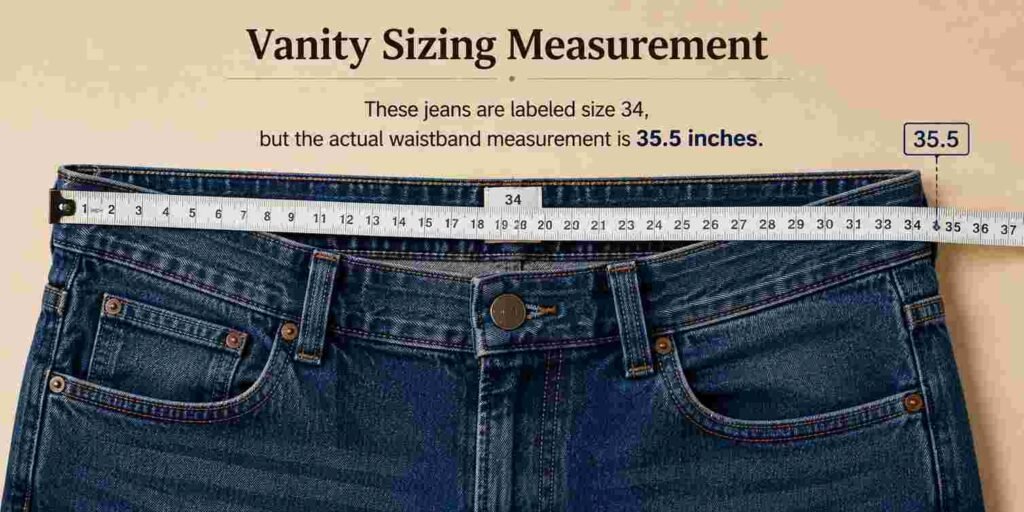
Dive Deeper: The Truth Behind the Size Tag
In my 20 years of making jeans, the number on the tag is one of the biggest points of confusion. The "size" is a commercial label, not always a direct statement of the garment's physical measurement.
This practice, often called "vanity sizing," started years ago and is now the industry standard. The idea is to make the customer feel good by fitting into a smaller size number.
For a designer like you, this creates a major challenge. Your vision depends on precision. That's why the technical pack is king. It must clearly define the actual, physical measurements for each size.[^3] At my factory, the first conversation we have about a new design is about the sizing specs. We need to know: is your "Size 34" meant to fit a person with a 34-inch waist, or is it supposed to measure 34 inches flat? Clarifying this prevents costly mistakes. Even with clear specs, there's always a small manufacturing tolerance, but a good factory keeps this to a minimum, maybe a quarter-inch, not an inch and a half.
| Brand Style | Size 34 Label | Actual Waistband Measurement |
|---|---|---|
| Slim-Fit Fashion Brand | 34 | 35" |
| Classic Comfort Brand | 34 | 35.5" |
| Traditional Workwear | 34 | 36" |
| Online Fast Fashion | 34 | 34.5" - 36.5" (Inconsistent) |
What is the 2 finger test for jeans?
You hear customers talk about a quick fit trick, but you're not sure what it is. The 2-finger test is a simple consumer hack. Here is what it means for your designs.
The two-finger test is how a customer checks a waistband's fit.[^4] They should be able to slide two fingers (index and middle) comfortably between their stomach and the jean's waistband. It's an informal check for a good fit, not a precise design measurement tool.
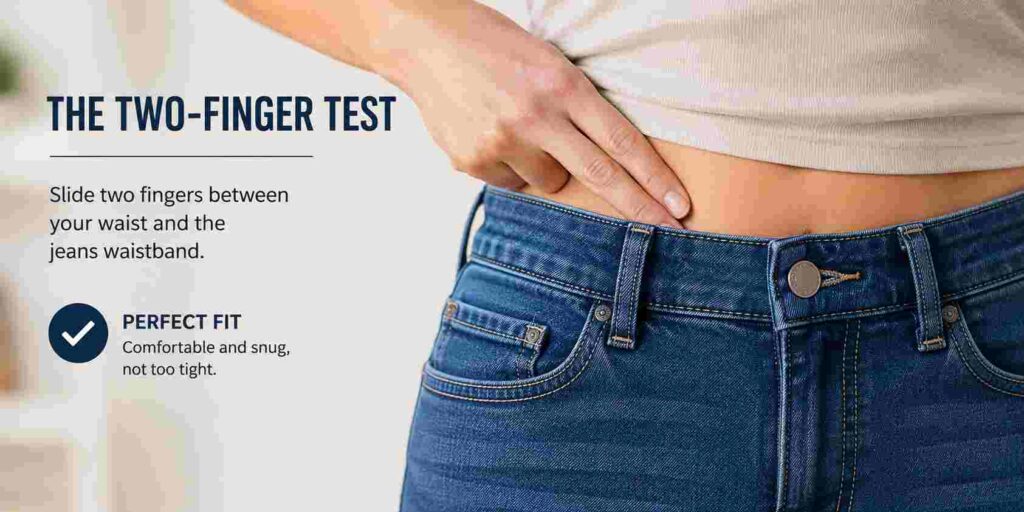
Dive Deeper: From Customer Hack to Design Insight
The two-finger test is a perfect example of the gap between how clothes are made and how they are worn. For the customer, it's a simple, intuitive way to ensure the jeans aren't too tight and have enough room for daily movement, like sitting down after a meal. They aren't using a tape measure; they are testing for comfort. As a designer, you shouldn't dismiss this. It's valuable feedback. It tells you that your target customer values comfort and a little bit of ease in the fit.
From my perspective as a manufacturer, our job is to translate your design intent into a physical garment that passes this test. This "ease" isn't an accident. It's intentionally built into the pattern based on your technical specs.
If your size 34 jean is designed to have an actual waistband of 35.5 inches, that 1.5 inches of ease is what allows for the two-finger test to work. The test is a result of good design and precise manufacturing, ensuring the final product provides the comfort your customers are looking for.
What is a size 32 in jeans equal to?
Struggling to translate men's waist sizes to women's numbered sizes for a unisex line? It's confusing because there's no universal standard. Let me clear up the most common conversions.
A men's size 32 waist roughly translates to a US women's size 12 or 14, but this is not an exact science. Women's sizing is notoriously inconsistent across brands.[^5] Using a detailed measurement chart is always more reliable than relying on a simple size conversion.
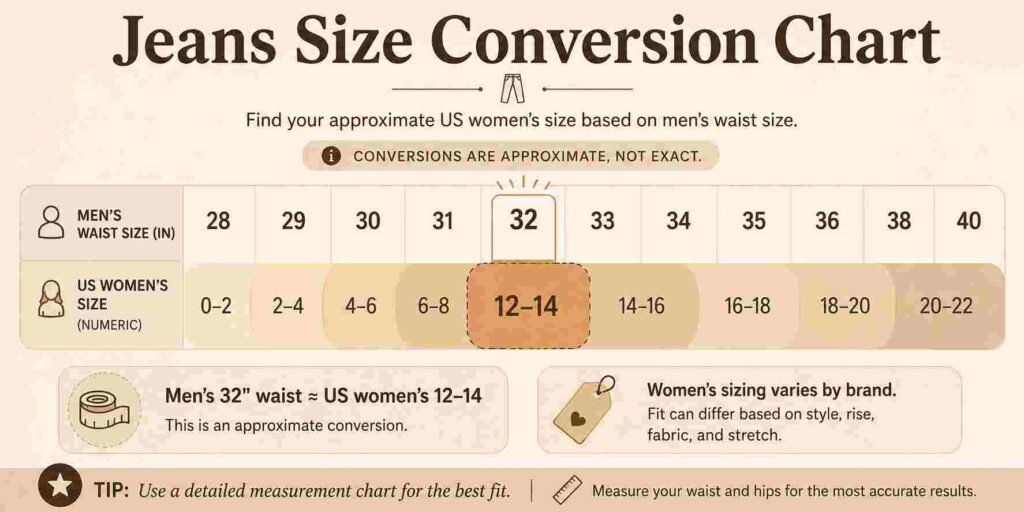
Dive Deeper: The Chaos of Sizing Conversion
Trying to create a standard conversion chart between men's and women's sizes is nearly impossible, and I've seen brands get into a lot of trouble trying. A men's "32" is a measurement-based system (even if it's vanity sized). A women's "12" is a completely arbitrary number that has changed over decades and differs wildly from one brand to the next. One brand's size 12 is another's 10 or 14.
This is where the supply chain becomes critical. A reputable brand with its own factory will create two separate, detailed size specifications: one for its men's line and one for women's. This is the only way to ensure a good fit. However, I've seen the dark side of this. Some traders buy huge lots of jeans from a factory clear-out.
They might all be the same physical size, say a 32-inch waist. To make a quick profit, they'll attach different labels. They'll sell the exact same pair of jeans as a Men's 32, a Women's 12, and a Women's 14. It's dishonest, and it's a disaster for any brand's reputation when a customer discovers this.
| Size System | Size | Approximate Body Waist | Garment Measurement |
|---|---|---|---|
| Men's | 32 | 32" | 33.5" - 34" |
| Women's (Brand A) | 12 | 31" - 32" | 33" |
| Women's (Brand B) | 12 | 32" - 33" | 34.5" |
Is a 29 waist a size 8 or 10?
Your fit model has a 29-inch waist, and you've always called that a size 8. But now you see other brands calling it a 6 or 10. This brand-to-brand variance is a major headache.
A 29-inch waist can be a size 6, 8, or 10 depending on the brand. There is no legally enforced standard for women's clothing sizes in the US or many other countries.[^6] Each brand creates its own unique sizing system based on its target customer.
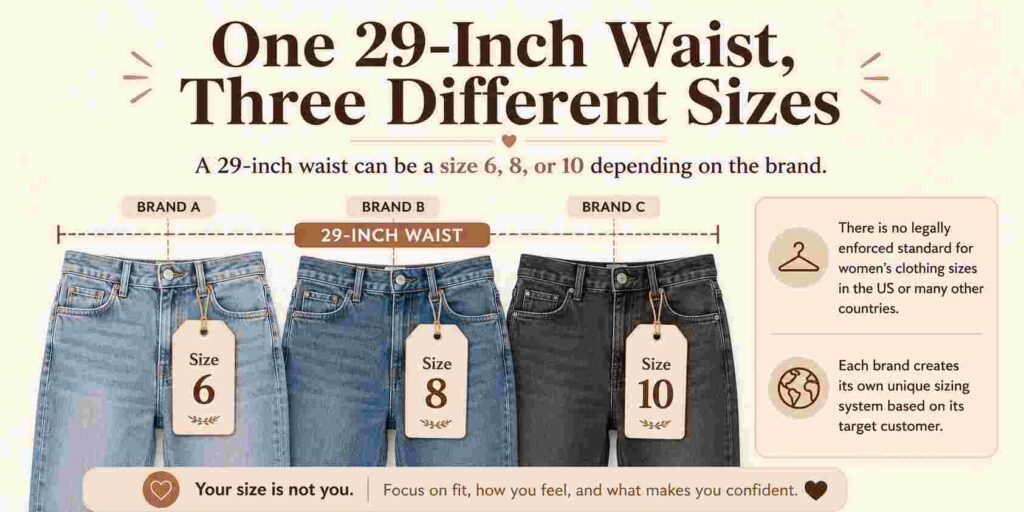
Dive Deeper: The Power of a Grade Rule
So, who is right? The brand that calls a 29-inch waist a size 6, or the one that calls it a 10? The answer is: the brand that is consistent. For a quality-focused designer like you, the number on the tag is less important than the promise of consistency that it represents.
The Brand Standard: Your Sizing Bible
A serious brand invests time and money into creating a 'Grade Rule'. This is the master document for your sizing. You start with a base size, for example, a Size 8 that fits your model perfectly. The Grade Rule then defines exactly how much the pattern needs to change for every other size.
It is incredibly detailed, specifying changes to the waist, hip, thigh, inseam, and rise. When we get a Grade Rule at DiZNEW, we treat it like a blueprint. It's our job to execute it perfectly so that your Size 12 is consistently different from your Size 10, in exactly the way you designed it. This is why having a dedicated factory partner is so important.
The Wholesaler Chaos: The Race to the Bottom
The opposite happens with low-end sourcing. I've seen it firsthand. A wholesaler buys a container of jeans for cheap. They might all be one size. To meet orders, they simply sew in whatever size labels they need. This is how a customer ends up with two pairs of jeans, a size M and a size XL, that are physically identical. This practice destroys customer trust, but it happens every day. Choosing a reliable manufacturing partner is your best defense against your brand being damaged this way.
Conclusion
In short, size labels are just guides for the customer. True fit consistency comes from a brand's commitment to detailed specs and a factory partner who can execute them flawlessly.
---

[^1]: "[PDF] Textile quality assurance: A comparison between education and ...", https://dr.lib.iastate.edu/bitstreams/532d5995-3bc0-4d36-af3e-c8cc63c4cd55/download. Apparel quality-control and textile references describe finished-garment measurements as subject to tolerances, brand specification systems, and dimensional change after laundering, supporting these as common sources of sizing variation. Evidence role: general_support; source type: education. Supports: Jean sizing differs because of manufacturing tolerances, differing brand standards, and fabric changes after washing.. Scope note: Such sources support the categories of variation generally; they may not quantify their relative importance for denim specifically.
[^2]: "Measurements for Fitting Pants | New Mexico State University", https://pubs.nmsu.edu/_c/C209/. Consumer sizing studies and apparel measurement surveys document that labeled trouser waist sizes often differ from measured waistband dimensions, supporting the claim that a nominal waist label is not necessarily the garment measurement. Evidence role: statistic; source type: research. Supports: A jean labeled size 34 often does not measure exactly 34 inches at the waistband.. Scope note: The degree of mismatch varies by sample, brand, garment category, and measurement method.
[^3]: "Constructing A Graded Specification Sheet - Fashion Index", https://www.fashionindex.com/blog/apparel-tech-pack-graded-specification-sheet. Fashion product-development and technical-design references describe the tech pack/specification sheet as the document that records garment measurements and graded size specifications for production. Evidence role: definition; source type: education. Supports: A technical pack should specify the physical measurements for each garment size.. Scope note: This supports standard technical-design practice, not the quality of any particular factory's execution.
[^4]: "Pressing Pointers - BE BOLD. Shape the Future.", https://pubs.nmsu.edu/_c/C309/index.html. Fit guidance from health, extension, or apparel education sources commonly describes finger-space checks at the waistband as an informal comfort assessment rather than a precise sizing standard. Evidence role: general_support; source type: education. Supports: The two-finger test is an informal way for consumers to assess waistband fit.. Scope note: This supports the test as practical consumer guidance, not as a standardized apparel measurement method.
[^5]: "Sizing is stopping consumers from shopping. Here's what brands ...", https://www.vogue.com/article/sizing-is-stopping-consumers-from-shopping-heres-what-brands-need-to-know. Apparel sizing research has documented substantial variation among brands' women's size charts and garment measurements, supporting the claim that women's sizes are inconsistent across brands. Evidence role: expert_consensus; source type: paper. Supports: Women's clothing sizes vary substantially across brands.. Scope note: The term 'notoriously' is rhetorical; evidence can support inconsistency but not the tone of the characterization.
[^6]: "Body Dimensions for Apparel | NIST", https://www.nist.gov/publications/body-dimensions-apparel. Government and standards-body materials indicate that apparel sizing standards are generally voluntary rather than legally mandated in the United States, supporting the claim that brands are not required to use one enforced women's size scale. Evidence role: general_support; source type: government. Supports: There is no legally enforced U.S. standard requiring brands to use a single women's clothing size system.. Scope note: The statement about 'many other countries' requires jurisdiction-specific confirmation; a U.S. source directly supports only the U.S. portion.