
You grab a larger size of jeans, hoping they'll hide everything and make you look slimmer. But you end up wondering if you just look baggy and bigger than before.
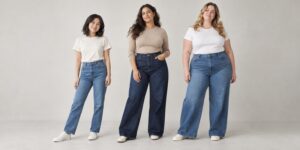
Yes, the right pair of bigger jeans1 can make you look smaller, but the style is more important than the size. A well-fitting wide-leg or straight-leg cut2 creates a slimming silhouette3, while a poorly sized skinny jean will not.

In my 20 years of making jeans, fit is the one thing we obsess over more than anything else. A designer like Dean knows that a fraction of an inch can change how a person feels in their clothes.
Simply going up a size isn't the magic answer. The secret lies in understanding which shapes and styles create long, clean lines on the body. Let's look at how to find the perfect slimming fit.
What Jeans Make You Look Skinnier?
You want a pair of jeans that is genuinely flattering, but every style claims to be the one. You're left confused about which cut actually works to make you look slimmer.
High-waisted styles with a straight, bootcut, or wide leg are the most effective for a skinnier look. They raise the waistline and create an unbroken vertical line, making you appear taller and leaner.
[^4]: high-waist straight, bootcut, and wide-leg](https://diznewjeans.com/wp-content/uploads/2025/10/high-waisted-styles-with-a-straight-bootcut-or.jpg "Jean Styles That Make You Look Skinnier")
Different cuts work in different ways to create a slimming illusion. It's all about playing with proportions.
High-waisted straight-leg jeans are a classic for a reason. They lift your natural waist, which instantly makes your legs look longer.
The straight cut then skims past your hips and thighs without clinging, creating one long, smooth line from your waist to your ankle. Another great option is a black micro-flare or bootcut jean.
Black is naturally slimming, and the slight flare at the bottom balances out your hips and thighs, making your entire leg look more proportional and sleek.
Finally, high-waisted wide-leg jeans4 are fantastic. They completely hide the shape of the leg underneath, creating a powerful, elongated silhouette.
The key to all of these is the high waist, because it redefines your body's proportions for the most flattering effect.
| Jean Style | How It Creates a Slimming Effect | Best For |
|---|---|---|
| High-Waist Straight-Leg | Lengthens the leg line, skims over thighs | Most body types, hiding thigh width |
| Black Micro-Flare/Bootcut | Balances the hips and thighs, adds length | Curvier figures, pear shapes |
| High-Waist Wide-Leg | Creates one long, unbroken vertical line | Hiding leg shape, making you look taller |
Is It Better to Go Smaller or Bigger with Jeans?
You are stuck between two sizes at the store. One feels a bit too snug, the other a little loose. You don't know which is the better choice for the long run.
It is almost always better to choose the slightly bigger size. A little extra room prevents squeezing and bulging, creating a smoother body line. You can always get the waist tailored for a perfect fit.

As a manufacturer, I deal with the realities of fabric every day. If you choose 100% cotton jeans, the smaller size might eventually stretch and mold to your body, but the break-in period can be very uncomfortable. For jeans with stretch, going too small is a big mistake.
The fabric will be pulled tight, which can highlight areas you'd rather not emphasize. Going a size up gives you breathing room. It lets the fabric drape properly instead of straining.
The most common issue with sizing up is a gap at the back of the waistband. But this is the easiest and cheapest alteration a tailor can make. A simple dart can perfect the waist, giving you a custom-fit feel.
You can't add fabric to a pair that's too small, but you can always perfect a pair that has a little extra room to begin with. The goal should be comfort and a smooth silhouette, which the bigger size nearly always provides.
What Is the 2 Finger Rule for Jeans?
You've probably heard someone mention the "2 finger rule5" for fitting jeans. It sounds straightforward, but what does it actually mean and why is it important for getting the right size?
The 2-finger rule is a simple test to check if the waistband of your jeans fits correctly. You should be able to slide two fingers comfortably between your waist and the back of the waistband.

This is a classic fit test that we use as a quick check, even in the factory. It's the perfect balance between too tight and too loose. If you can't get your fingers in there at all, the waistband is too tight.
This will not only be uncomfortable when you sit down, but it will also likely squeeze you and create a "muffin top" effect. The pressure from the tight band has to go somewhere.
On the other hand, if you can easily fit your entire fist in the back, the jeans are too big. They will gap when you sit and you'll constantly be pulling them up. Two fingers (your index and middle finger, stacked flat) is the sweet spot.
It means the jeans are snug enough to stay in place but give you enough room to move, breathe, and tuck in a shirt without straining the fabric. It's a simple, reliable trick to ensure your comfort all day long.
Why Do Jeans Make My Belly Look Big?
You found a pair of jeans that fits your legs perfectly, but when you look in the mirror, they seem to accentuate your stomach. It's a common and frustrating problem.
Jeans can make your belly look big if they are a low-rise style6, made from unsupportive fabric7, or are simply the wrong size. These factors can either squeeze the abdomen or fail to hold it in.

There are a few key culprits here. The most common one is a low-waist design. Low-rise jeans sit below your natural waist, and their waistband can cut right across the soft part of your belly, causing it to push outwards.
A high-waisted jean, by contrast, sits at the narrowest part of your torso and provides coverage and support. The second issue is fabric. Jeans made with cheap, overly soft stretch material that has poor recovery won't offer any structure.
A good quality denim with a bit of rigidity will hold you in and create a smoother line. Third is size. If the jeans are too tight, they will squeeze your abdomen and make it look more prominent.
But surprisingly, if they are too loose around the waist and hips, the extra fabric can bunch up and add visual bulk8 right where you don't want it.
Finally, pay attention to design details. Jeans with tiny front pockets or a poorly set zipper can also cause awkward bulging.
Conclusion
Bigger jeans can make you look smaller, but only if they are the right style. Focus on the cut—like a high-waisted straight-leg—rather than just the size on the tag.
-
Explore how bigger jeans can enhance your silhouette and comfort, making them a stylish choice. ↩
-
Understand how a straight-leg cut can create a balanced and flattering look for your legs. ↩
-
Learn about the importance of a slimming silhouette in fashion and how it can boost your confidence. ↩
-
Explore the benefits of wide-leg jeans and how they can create an elongated silhouette. ↩
-
Discover the 2 finger rule and how it can help you find the perfect fit for your jeans. ↩
-
Understand the potential issues with low-rise jeans and how they can affect your appearance. ↩
-
Explore the importance of supportive fabric in jeans for a flattering and comfortable fit. ↩
-
Learn about factors that contribute to visual bulk in jeans and how to choose wisely. ↩