
You design a beautiful pair of jeans, but the pockets start to tear after a few months of wear. It's a frustrating failure point. I'll tell you how a tiny piece of metal solved this problem 150 years ago.
Those metal "buttons" are actually rivets. Their job is to reinforce the jean's weakest points, like the corners of your pockets, by clamping the fabric together to prevent tearing. They are a small but essential piece of functional hardware.
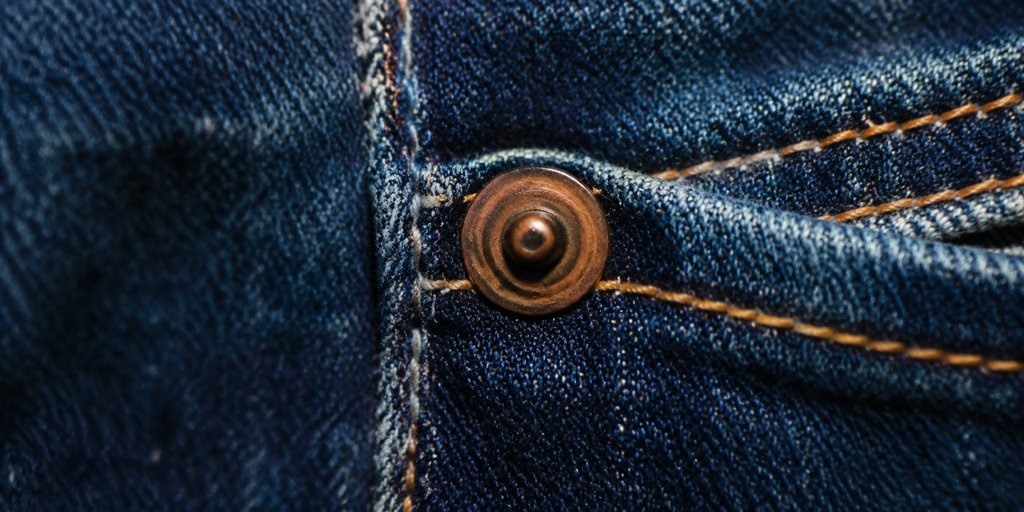
In my two decades of running a denim factory, I've handled millions of these tiny metal parts. They might seem like just a decoration now, but they are the entire reason blue jeans as we know them exist. They were born from a real-world problem during the California Gold Rush. For a designer like you, understanding this history is key, because it gets to the heart of what makes denim authentic. Let’s explore the story behind this iconic piece of hardware.
Why do jeans have those metal rivets?
You see those metal studs on every pair of jeans, but what are they actually for? It seems like a small detail. I'm here to tell you that this detail is everything.
Metal rivets are there to reinforce high-stress areas, especially the pocket corners[^1]. They act like a clamp, holding layers of denim together far more securely than thread alone.[^2] This simple addition is what made jeans tough enough for hard labor.
Dive Deeper: A Miner's Problem, A Tailor's Solution
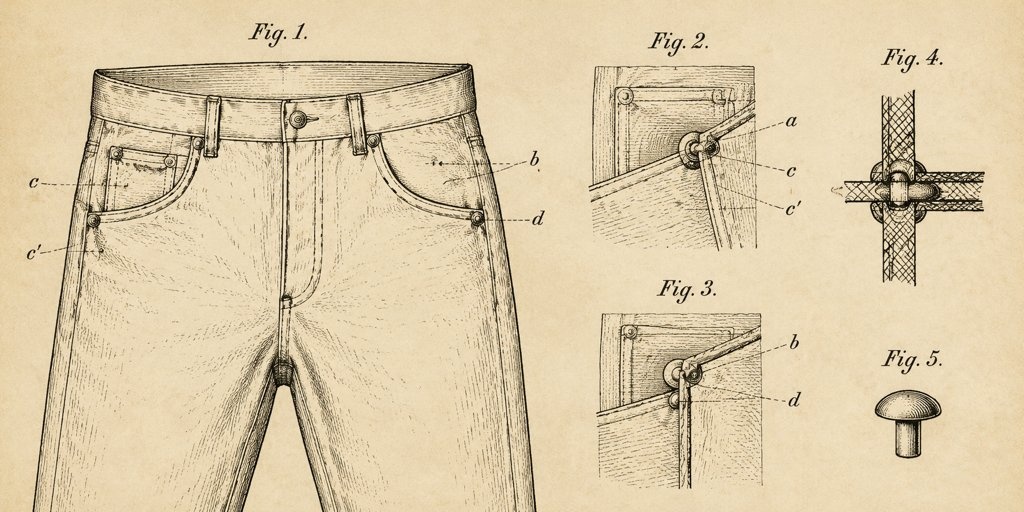
The story begins with the gold miners of the 1800s[^3]. They were stuffing their pockets with heavy tools and rocks, and the pocket seams were constantly ripping. A tailor named Jacob Davis had a customer who kept coming back for repairs. Frustrated, Davis got an idea from the copper rivets used on horse blankets[^4] to strengthen the straps. He hammered some onto the corners of the pockets. It worked. The pants became almost indestructible.
Realizing he had a great idea, Davis partnered with his fabric supplier, Levi Strauss. Together, they got U.S. Patent No. 139,121 in 1873 for "An Improvement in Fastening Pocket-Openings." This patent marks the official birth of the modern blue jean. What started as a simple fix became the defining feature of the world's toughest pants. Today, they are still functional, but they also serve as a powerful symbol of denim's workwear heritage.
| Era | Primary Role of Rivets |
|---|---|
| 1870s | Purely functional, to stop pockets from tearing on miners' work pants. |
| 1950s | Functional, but also a symbol of rebellious youth culture. |
| Today | Largely decorative, signaling authenticity and brand identity. Still functional at stress points. |
Are Levi's rivets copper?
You’re selecting hardware for a new design, and the material matters. Does it have to be copper? Let's look at the original choice and why it was so effective.
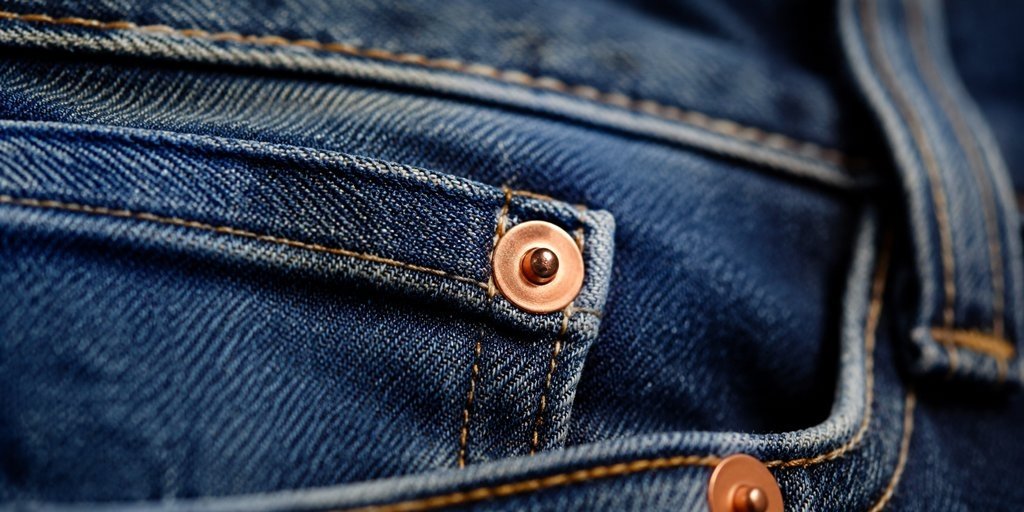
Yes, the original Levi's rivets were made of copper[^5], chosen for its strength and resistance to rust. While many rivets on modern jeans are still copper or have a copper finish, other alloys like brass and zinc are also common today.
Dive Deeper: The Evolution of a Classic
The classic copper rivet has its own fascinating history. The original jeans had rivets on the back pockets as well as the front. But in 1937, Levi's started hiding the back pocket rivets[^6]. Why? Because cowboys complained that the exposed copper rivets were scratching their saddles. School kids also found they were scratching up their wooden desks. It’s a great example of design adapting to customer feedback.
Then, during World War II, metal was rationed for the war effort. To save materials, rivets were removed from the crotch and other non-essential spots. After the war, new sewing technology like the bar tack stitch—that dense block of thread you see at stress points—proved strong enough to replace even more rivets. What was once a purely functional piece of hardware evolved into a carefully considered design element, a mark of history and brand identity. As a designer, your choice of rivet finish—aged copper, shiny nickel, matte black—is a key part of the story you're telling.
What color is denim before it's dyed?
We think of denim as blue, but that's just a surface treatment. The soul of the fabric starts out completely different. I’ll show you the true color of our canvas.
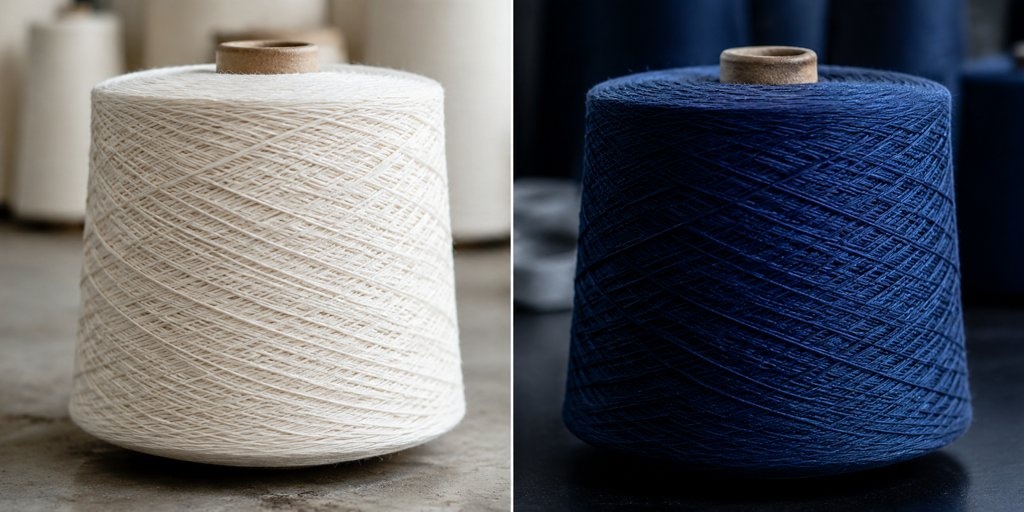
Dive Deeper: The Warp, The Weft, and The Rivet
The classic denim look is a beautiful interplay of three colors. In my factory, we start with cones of this off-white "greige" yarn. To make denim, we take one set of yarns, called the warp, and dye them a deep blue with indigo. The other set of yarns, the weft, is left in its natural white state. When we weave them together in a twill pattern, the blue warp threads dominate the surface, but the white weft threads peek through. This is why the face of your jeans is blue and the inside is whitish.
This technical detail is the secret to denim's unique character. When it fades, the blue indigo chips away, revealing more of the white core of the yarn and the white weft threads underneath. Now, add the third color to this palette: the warm, metallic glint of a copper rivet. The combination of indigo blue, natural white, and raw copper is the visual DNA of a classic blue jean. It’s a perfect design system.
What is the 2 finger rule for jeans?
You create a design with perfect proportions, but it just doesn't fit people right. A simple, old-school rule can solve this frustrating problem, and it's all about the waistband.
The two-finger rule is a quick fit test for the waistband. You should be able to slide two fingers snugly between your body and the waistband. This confirms the jeans are comfortable but won't fall down, striking the perfect balance.
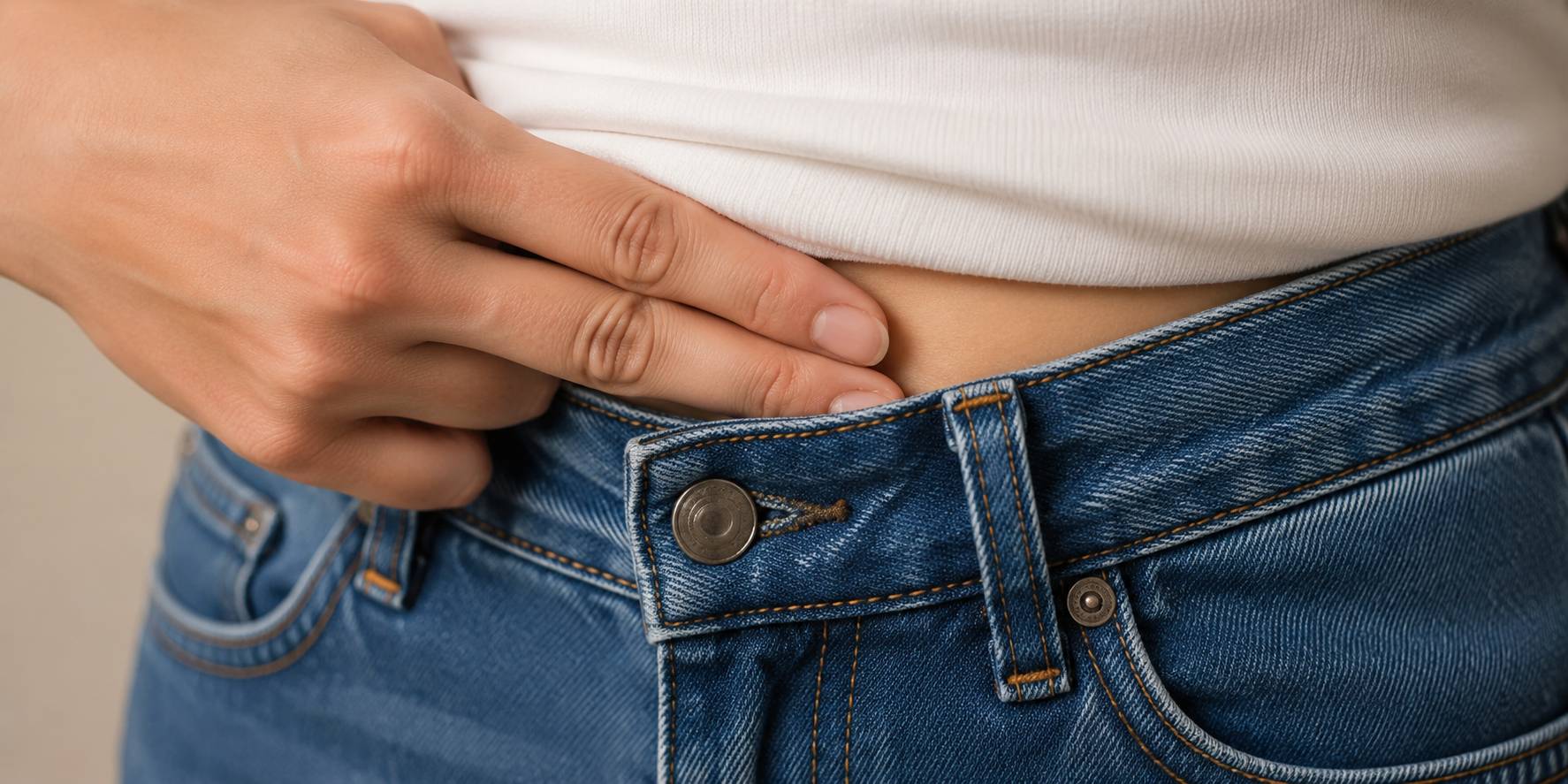 "The Two-Finger Fit Rule")
Dive Deeper: How Fit Protects Our Hardware
This rule seems simple, but it's directly related to the structural integrity of the entire garment, including the rivets. Jeans that are too tight put constant, extreme strain on every component. The fabric is stretched taut, the seams are pulled, and the hardware is under constant tension. When a person sits or bends, the force is immense.
While we install rivets to handle stress, their job is to protect against the strain of normal activity, not to fight against a fundamentally bad fit. A proper fit allows the garment to work as a system. The fabric flexes, the seams hold, and the rivets are there as the final line of defense at the most critical points. From my perspective as a manufacturer, creating a durable product starts with a design that allows for a proper fit. It ensures the strength we build into the jean isn't wasted by unnecessary stress before it even leaves the store.
Conclusion
Those copper rivets aren't just decoration. They are a direct link to the Gold Rush, born from a need for durability. Today, they are a hallmark of authentic, quality-made jeans.
---

[^1]: "Forever in Blue Jeans…and in Court - Pieces of History", https://prologue.blogs.archives.gov/2010/05/20/forever-in-blue-jeansand-in-court/. A source on riveted garments or the original pocket-fastening patent should support that metal rivets were introduced to strengthen pocket openings and other stress points by mechanically fastening fabric layers together. Evidence role: mechanism; source type: government. Supports: Metal rivets reinforce high-stress areas of jeans, especially pocket corners.. Scope note: The evidence may establish the mechanism and historical purpose of rivets generally rather than test the durability of the specific jeans described in the article.
[^2]: "[PDF] elq5314.tmp - NASA Technical Reports Server", https://ntrs.nasa.gov/api/citations/19930084165/downloads/19930084165.pdf. A technical textile or fastening reference should support that rivets provide mechanical clamping through layered material and are used where stitching alone is vulnerable to concentrated stress. Evidence role: mechanism; source type: research. Supports: Rivets clamp layers of denim together more securely at stress points than thread alone.. Scope note: A general fastening source may explain the mechanical principle without comparing every denim construction or stitch type quantitatively.
[^3]: "Levi Strauss Jeans | Smithsonian Institution", https://www.si.edu/collections/snapshot/levi-strauss-jeans. A historical source on nineteenth-century workwear or the California Gold Rush should contextualize the demand for durable trousers among miners and laborers in the American West. Evidence role: historical_context; source type: encyclopedia. Supports: The origin story of riveted jeans is linked to nineteenth-century miners and laborers.. Scope note: Such a source may support the broader labor context rather than prove that every early customer was a gold miner.
[^4]: "Jacob W. Davis - Wikipedia", https://en.wikipedia.org/wiki/Jacob_W._Davis. A historical source on Jacob Davis’s design should support that he adapted copper rivets already used in other durable goods, such as horse blankets or harness-related items, to reinforce trousers. Evidence role: historical_context; source type: institution. Supports: Jacob Davis adapted copper rivets from horse blankets or similar durable goods for trousers.. Scope note: Some sources describe the inspiration as horse blankets or harnesses; wording should reflect the source’s exact formulation.
[^5]: "Levi Strauss & Co. - Wikipedia", https://en.wikipedia.org/wiki/Levi_Strauss_%26_Co.. A historical source on Levi Strauss & Co. or the original Davis-Strauss patent should support that the early riveted waist overalls used copper rivets. Evidence role: historical_context; source type: institution. Supports: The original Levi’s rivets were copper.. Scope note: Company archival sources are directly relevant but may not be fully independent; the patent or museum sources can provide corroboration.
[^6]: "The 80-Year Coverup - Levi Strauss & Co", https://www.levistrauss.com/2017/07/06/80-year-cover/. A Levi Strauss archival or museum source should support that exposed back-pocket rivets were concealed around 1937 after complaints that they scratched saddles and furniture. Evidence role: historical_context; source type: institution. Supports: Levi’s concealed back-pocket rivets in 1937 because exposed rivets damaged saddles and desks or furniture.. Scope note: Because this concerns a specific Levi’s product decision, company archives may be the most direct source, though not fully independent.