
You ruin pants quickly on a farm. Soft fabric rips constantly. You must discover the cowboy secret to tough clothing today.
Cowboys starch jeans. They make the soft cotton yarn strictly tough. The starch acts like a strong glue. It forms a protective film over the denim fibers.[^1] This heavy starch protects clothes from hard wear and dirt.
Your pants rip on hard tools often. You feel very angry. I operate the DiZNEW denim manufacturing factory smoothly. I have worked with deep denim washing techniques for twenty years. My New York design partner Dean builds great tough clothing. We understand industrial fabric strength completely. We will explore the strict science behind stiff starched pants now.
Why do cowboys like starched jeans?
Weak pants tear on horse saddles. Soft jeans fail during hard ranch work. Hard stiff pants solve this big cowboy problem correctly.
Cowboys like starched jeans. The starch increases pure yarn strength greatly.[^2] The chemical sizing liquid acts like a strong glue. It binds the soft cotton fibers closely together tightly. The clothes become incredibly hard.
You spend money on weak pants blindly. You need tough gear for dirty outdoor jobs. I cut thick raw cotton inside my large factory everyday. I completely know how starch changes soft fabric. We coat the soft raw warp yarns with a thick starch film before the weaving process.[^3]
The Strong Glue Effect
This starch film acts as a powerful wet glue. The soft blue cotton yarn becomes very tough. The stiff fabric stops hard horse saddles from rubbing human skin. Dean requires this exact stiff fabric for his custom outdoor brand. He sketches hard pants for working men. We use heavy starch to protect the final new clothing. The starch stops dirt and thick mud from entering the cotton fibers easily.[^4] Cowboys slide off horses safely. The hard pants take the damage cleanly. Human skin stays safe. Starch keeps the blue denim looking clean and sharp. You look strong in stiff clothes.
| Cowboy Problem | Starch Solution Action | Final Pant Result |
|---|---|---|
| Soft fabric rips | Binds cotton fibers tightly | Creates very hard strong pants |
| Dirt enters clothes | Blocks mud out purely | Keeps pants fully clean easily |
| Horse rubs skin | Forms a stiff shield | Protects the cowboy leg safely |
What is the point of starched jeans?
Factories break soft yarn easily during production. Expensive weaving machines ruin weak cotton. Starch saves the raw denim from total destruction quickly.
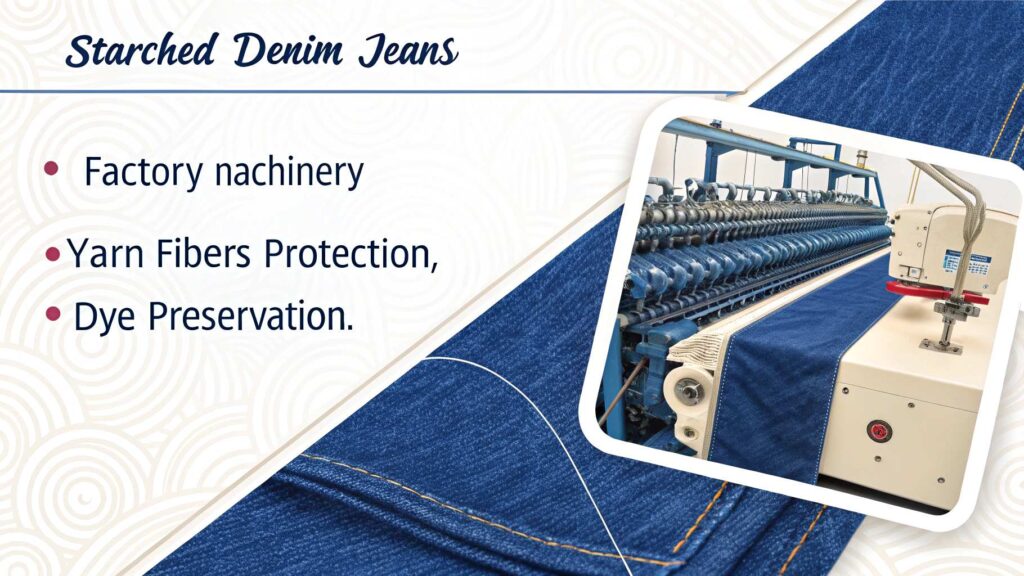
The main point of starched jeans is factory protection. The starch lowers mechanical machine friction. It allows the soft yarn to survive three thousand fast stretches.[^5] Starch also prevents fresh indigo dye from fading widely.
Soft cotton yarn breaks very fast on big industrial machines. The factory loom pulls the thin string very hard. I manage these huge fast weaving machines at DiZNEW constantly. We absolutely must add starch to the blue yarn strongly. The machine stretches the yarn five thousand times rapidly.
Factory Loom Protection Science
The starch creates a clean thick lubricating layer exactly over the soft yarn surface. The fast metal machine parts do not cut the cotton fibers. We weave the heavy denim smoothly. Fresh indigo blue dye rubs off soft cotton very fast without protection.[^6] The starch layer seals the wet blue color onto the yarn entirely. The dye does not pollute other factory machines. Dean buys this exact stiff raw denim from me. He ships thick stiff pants to his city customers. Cowboys buy these pants from standard stores. They strictly want the original hard factory protection on their bodies.
| Factory Challenge | Starch Chemical Value | Manufacturing Result |
|---|---|---|
| Machine friction cuts yarn | Creates a slick surface layer | Looms weave the fabric safely |
| Yarn stretches 5000 times | Makes yarn strong and tough | Yarn survives the pull easily |
| Fresh indigo dye fades | Seals the wet color tight | Keeps the factory clean fully |
What is the 2 finger rule for jeans?
Tight jeans hurt your waist terribly. Heavy stiff pants squeeze your body closely. You must find the proper waist fit for thick denim.
You must use the two finger rule. You fit exactly two flat fingers inside your jeans waistband securely. Two fingers prove the pants are perfectly comfortable. Stiff starched jeans do not stretch easily. You need extra waist room.
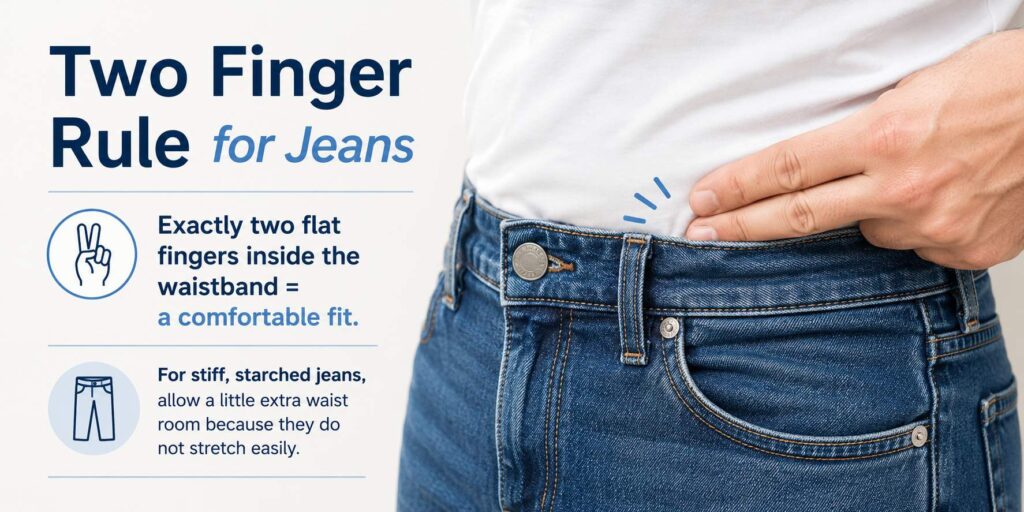
You buy tight hard pants often. Stiff starched pants never expand around your body. They cut into your stomach after heavy meals. I check waist sizes on thick pants at my factory actively. You must use the simple two finger rule correctly. You put two human fingers between your stomach skin and the hard waistband.
Finding Perfect Waist Comfort
The pants fit correctly. You slide two fingers perfectly down. You have enough waist room to breathe heavily. You can sit on a horse saddle happily. The heavy pants will not drop down. Dean completely enforces this strict waist rule for his New York denim brand. We design heavy stiff clothing exactly for this specific finger gap. Too much space causes a huge problem. The heavy pants slide completely down your legs. Too little space causes intense stomach pain. We stop this pain with careful sizing.
| Finger Test Result | Waist Fit Status | Daily Body Experience |
|---|---|---|
| Zero fingers fit | Waist is too incredibly tight | Causes pain during sitting |
| Exactly two fingers | Waist size perfectly correct | Gives comfortable safe room |
| Whole hand fits | Waist is way too big | Heavy pants fall down easily |
Do cowboys still starch their jeans?
Modern clothes feel weak. Soft jeans destroy cowboy culture slowly. Real cowboys still require thick hard pants directly.
Real cowboys definitely still starch their jeans heavily today. Heavy starch preserves the cowboy lifestyle tradition. Starch provides physical armor against hard tree branches. Cowboys prefer this old stiff custom style for daily ranch work loudly.
Pure modern fashion brands sell soft thin stretch pants wildly. You easily get hurt wearing thin soft pants on a real working farm. Genuine cowboys reject these weak modern fashion trends strongly. They still starch their blue pants every single week. I provide classic rigid starch denim to these working men firmly. We categorically refuse to wash the heavy starch out of the blue fabric.
The Modern Cowboy Armor
Cowboys rely on our hard thick cloth. The starch creates real physical armor against nature. A stiff pant leg stops sharp thorns purely. The heavy fabric falls directly straight down over tall hard cowboy boots naturally. A soft pant leg bunches up wrongly. Dean designs thick modern western wear for these men smoothly. He orders my stiffest unwashed factory denim. He fully respects the old tough working tradition. Cowboys will always use starch. They keep their dangerous lives safely protected.
| Modern Pants Issue | Cowboy Tradition Solution | Action On The Ranch |
|---|---|---|
| Thin soft stretch fabric | Buy hard stiff raw denim | Gives thick working protection |
| Pants drag near shoes | Hard crease falls straight | Covers the tall riding boots |
| Fashion pants rip fast | Heavy starch acts as glue | Lasts for long work years |
Conclusion
Cowboys starch their jeans to protect the cotton fibers and their own skin. Stiff factory denim acts like a thick strong glue against hard daily ranch work fully.
---

[^1]: "Formulations and performance of eco-friendly raw starch sizing ...", https://bioresources.cnr.ncsu.edu/resources/formulations-and-performance-of-eco-friendly-raw-starch-sizing-process/. Textile-sizing literature describes starch-based sizes as forming a temporary film around yarns and fibers, supporting the stated film-forming mechanism; this is direct for yarn sizing but only contextual for starch applied to finished jeans. Evidence role: mechanism; source type: paper. Supports: Starch forms a protective film over denim fibers.. Scope note: Industrial warp sizing may not behave identically to home starching of completed denim garments.
[^2]: "Performance Evaluation of the Sizing of Cotton Warp Yarns Using ...", https://pmc.ncbi.nlm.nih.gov/articles/PMC12845530/. Studies of warp sizing report that starch-based sizing can improve yarn strength, abrasion resistance, and weaving performance, supporting the claim that starch can strengthen cotton yarn during use; the magnitude of improvement depends on yarn type and formulation. Evidence role: mechanism; source type: paper. Supports: Starch increases cotton yarn strength.. Scope note: The word “greatly” would require quantitative data for the specific denim and starch recipe.
[^3]: "[PDF] cotton slashing - (part 2)", https://www2.cs.arizona.edu/patterns/weaving/monographs/ics5473b.pdf. Standard textile-manufacturing references describe warp sizing as the application of starch or other sizing agents to warp yarns before weaving, supporting the manufacturing sequence described here. Evidence role: definition; source type: education. Supports: Warp yarns are commonly coated with starch-based size before weaving..
[^4]: "Performance Evaluation of the Sizing of Cotton Warp Yarns Using ...", https://pmc.ncbi.nlm.nih.gov/articles/PMC12845530/. Textile-finishing sources on starch and sizing can support that surface films may reduce direct contact between soil and cotton fibers, but this is contextual evidence and should not be read as proof that mud cannot penetrate starched denim in outdoor work. Evidence role: mechanism; source type: paper. Supports: A starch film may reduce dirt or mud penetration into cotton fibers.. Scope note: The support would be indirect unless the source tests mud penetration on starched denim specifically.
[^5]: "Performance Evaluation of the Sizing of Cotton Warp Yarns Using ...", https://pmc.ncbi.nlm.nih.gov/articles/PMC12845530/. Textile-weaving sources can document that warp yarns undergo repeated cyclic tension and abrasion on looms and that sizing helps them withstand these stresses; the exact figure of three thousand stretches would require machine-specific production data. Evidence role: general_support; source type: paper. Supports: Sizing helps yarn survive repeated stretching and stress during weaving.. Scope note: Likely sources will support repeated stress and the role of sizing, not the precise number “three thousand.”
[^6]: "Indigo dye may rub off on skin or fabrics - Facebook", https://www.facebook.com/groups/291023511046957/posts/2804210669728216/. Textile literature on indigo-dyed denim describes crocking, the transfer of indigo from fabric surfaces by rubbing, supporting the claim that indigo can rub off; it does not necessarily show that starch is the primary protection against this effect. Evidence role: mechanism; source type: paper. Supports: Fresh indigo dye can rub off cotton denim through crocking.. Scope note: This supports indigo rub-off generally, while the protective role of starch may need a separate source.