
You want cool ripped pants. You hate paying high store prices. I will teach you the exact simple method today.
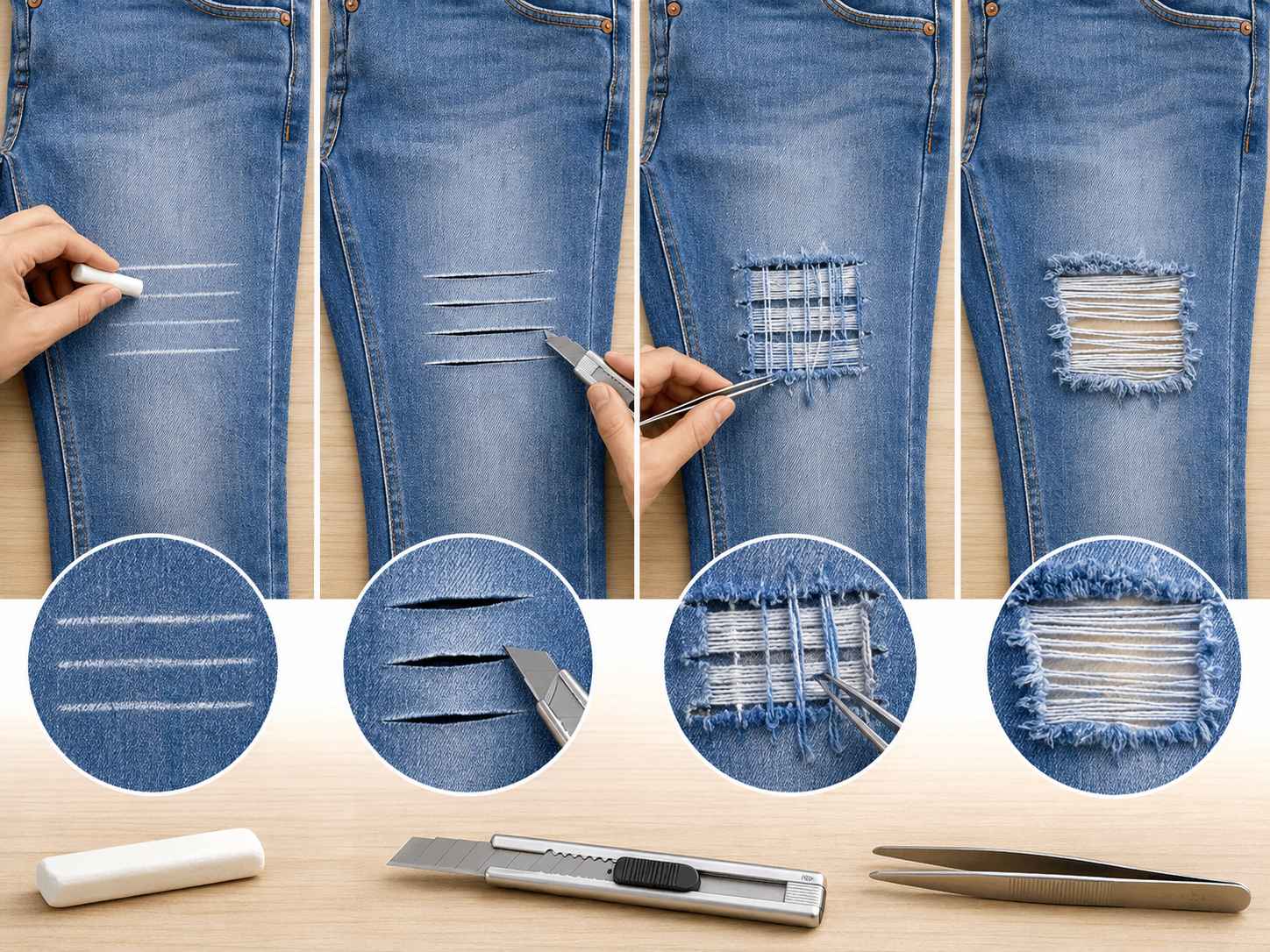
You make holes in your jeans easily at home. You need simple chalk, metal tweezers, and a sharp utility knife. You mark the knee area clearly. You cut straight horizontal lines gently. You pull the vertical blue threads out naturally. You keep the white threads whole safely.
You must read my exact fabric cutting secrets below. Poor rough cutting completely ruins thick expensive cotton entirely.[^1]
How to make holes in jeans easy?
You fear destroying your good pants completely. You cut a massive ugly hole yesterday. I will show you the safe beginner technique cleanly.
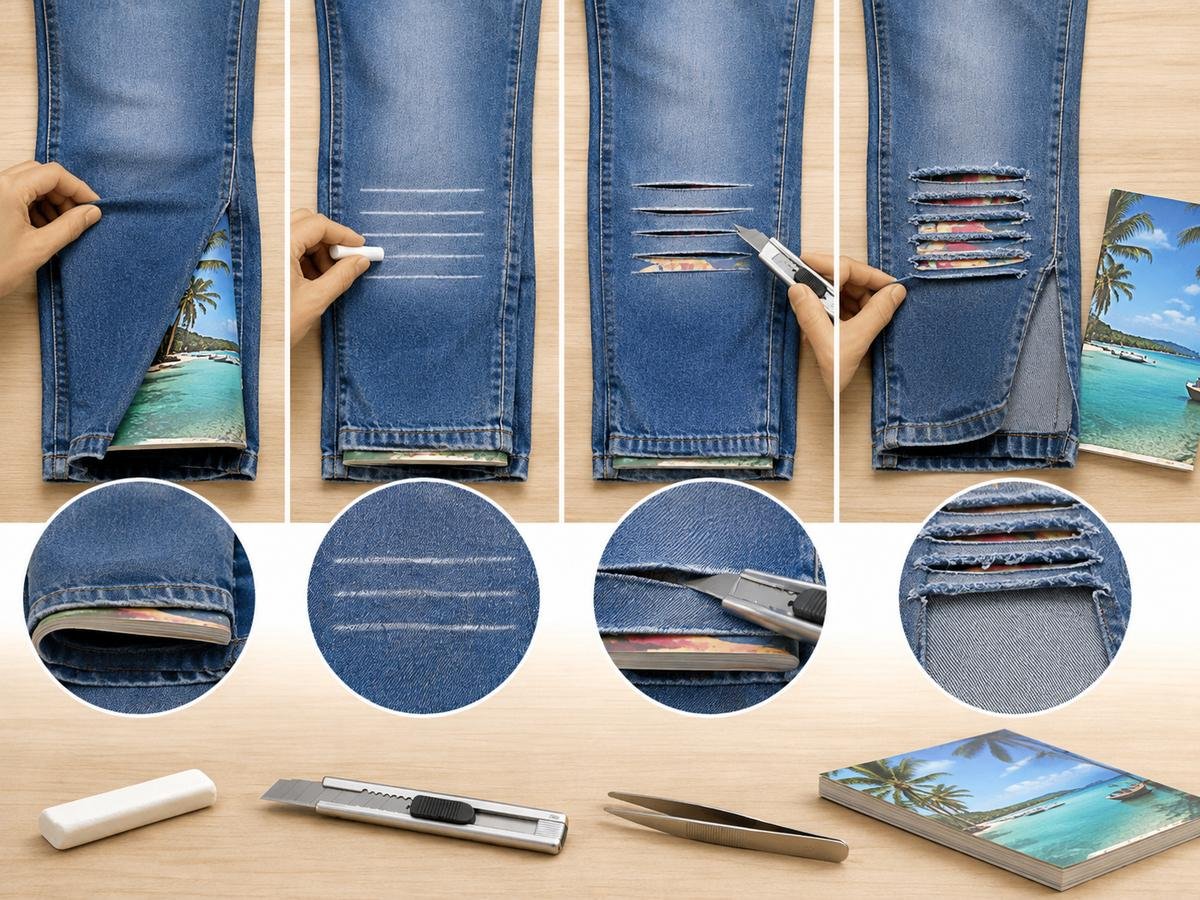
You make holes easy by inserting a thick magazine inside the pant leg first. This simple hard barrier stops the sharp knife exactly. You protect the back fabric layer[^2] completely. You only cut the top front layer safely.
The Safe Preparation Step
I see many ruined pants inside my DiZNEW factory often. Dean brings me bad sample pieces from New York constantly. Young designers cut raw fabric without inside protection blindly. They destroy the complete pant leg totally. You insert a heavy thick magazine immediately. You use hard flat cardboard alternatively. You push the hard barrier heavily into the long leg deeply. You place it precisely under the planned hole area exactly. You pick a basic sharp utility knife safely. You draw exact target lines with plain white chalk boldly. I suggest picking the natural knee area smartly. You draw chalk lines five centimeters above the knee cap carefully. You draw lines five centimeters below the knee cap cleanly. This specific target zone looks entirely natural loudly. You press the sharp metal knife onto the flat fabric gently. You cut clear flat slashes cleanly. The hard paper magazine catches the sharp metal blade safely. The back cloth layer stays completely untouched perfectly.
| Work Tool Name | Physical Action Goal | Home Object Alternative |
|---|---|---|
| Heavy thick magazine | Blocks heavy sharp knife totally | Hard thick old cardboard |
| Plain white chalk | Draws strict perfect target lines | Simple wet white soap |
| Sharp metal utility knife | Cuts raw thick fabric strongly | Sharp precise metal razor |
How to make your jeans holey?
You want a natural vintage style. You see ugly square box cuts locally. I will explain the perfect diamond shape trick clearly.
You make your jeans naturally holey by cutting unequal slit lengths. You cut short lines at the top. You cut longer lines in the middle. You cut short lines at the bottom again. This creates a beautiful diamond shape perfectly.
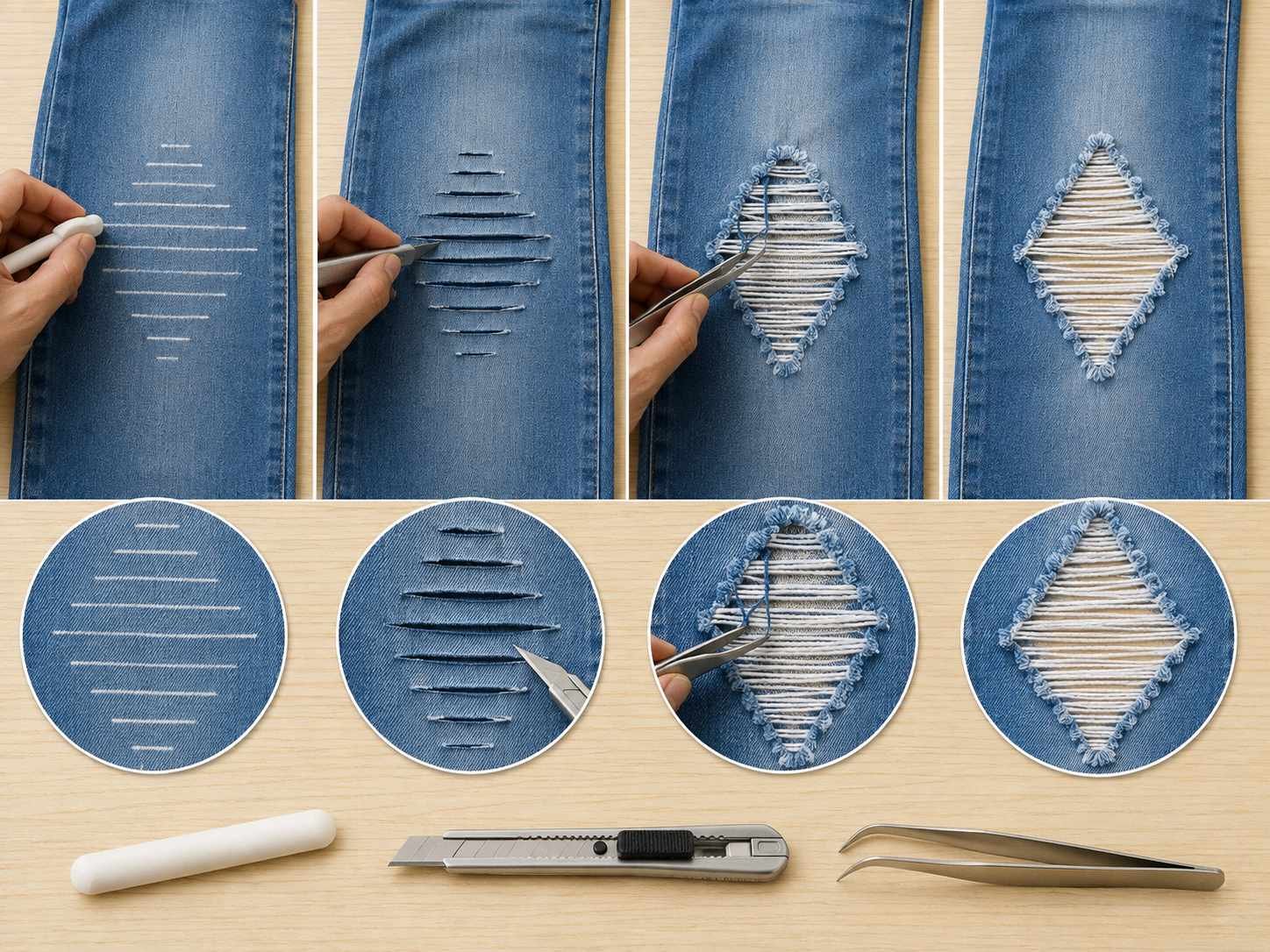
The Diamond Cutting Shape
I carefully design premium vintage looks for heavy clients daily. You look at old natural worn pants closely. Natural holes never look like perfect exact boxes strictly. You mimic natural physical human wear exactly. You take your sharp utility knife confidently. You cut horizontal lines one centimeter apart[^3] precisely. You make the absolute top cut very short cleanly. You make the next lower cut slightly longer carefully. You cut the middle lines the longest widely. You reduce the cut length toward the bottom edge gradually. You build a visual diamond shape completely naturally. You avoid looking like a cheap factory machine entirely. Dean demands this exact irregular look for his expensive clients loudly. Perfect straight equal lines look highly artificial[^4] cleanly. You make the cuts loosely. You let the sharp metal knife glide smoothly. You open the first cut gap gently. You separate the raw edge threads carefully. You see thick pure white threads safely. You see stiff blue threads clearly.
| Knife Slash Position | Exact Required Length | Final Visual Feeling |
|---|---|---|
| Absolute top line | Very short loose cut | Starts the natural tear slowly |
| Middle fabric area | Extremely long wide cut | Shows the huge main hole clearly |
| Exact bottom edge | Very short plain cut | Ends the physical hole cleanly |
Can I cut holes in my own jeans?
You feel totally unsure about your simple hand skills. You think only big factories do this well. I will teach you the exact thread pulling trick.
Yes, you can cut holes in your own jeans successfully. You use small metal tweezers carefully. You isolate the long white horizontal threads gently. You pull out the short vertical blue threads slowly. You clear the entire hole cleanly.
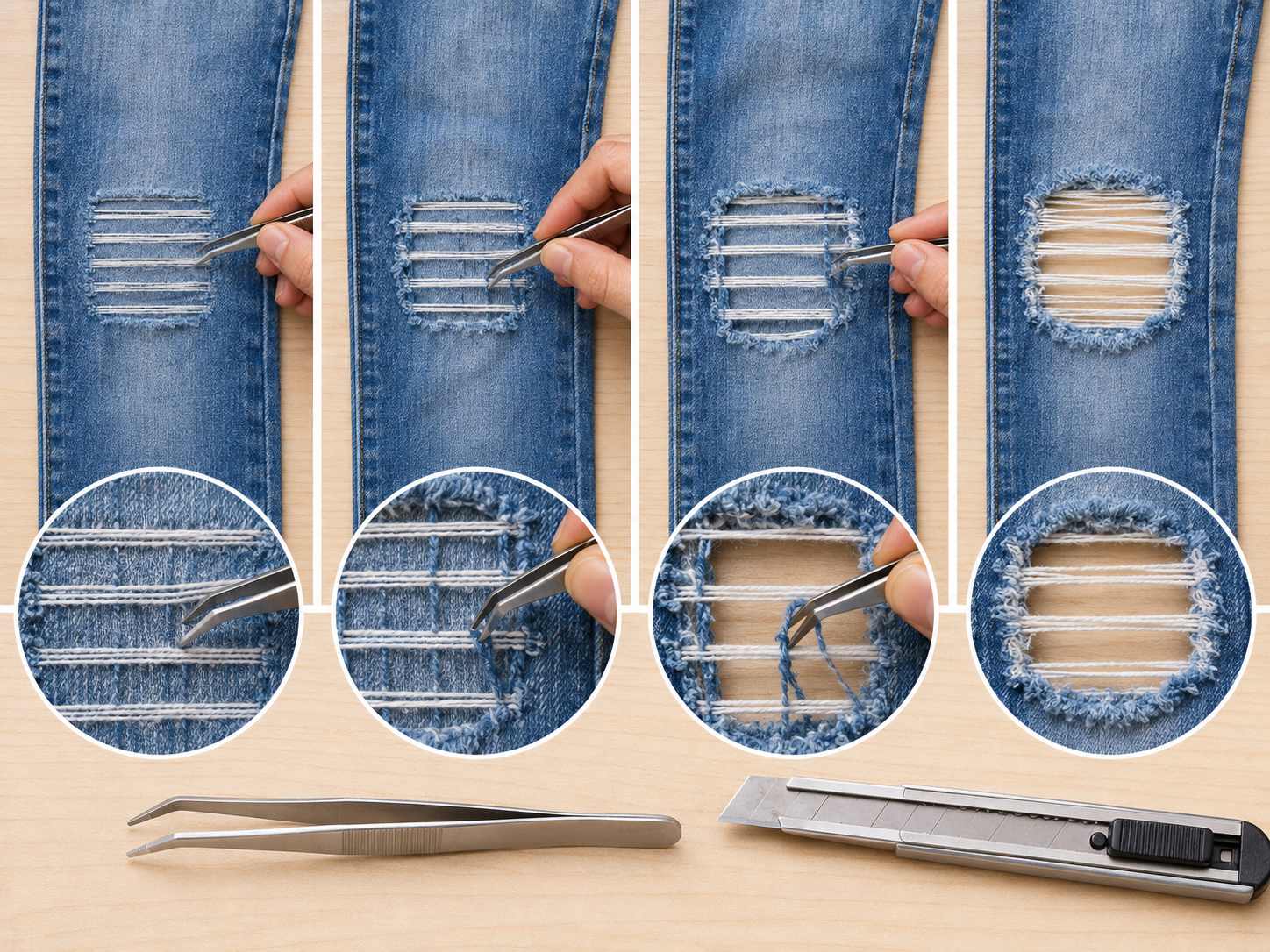
The Thread Plucking Action
I train new young factory workers this exact physical skill yearly. You need pure human patience entirely. You grab basic clean metal tweezers securely. You focus on the freshly cut diamond area closely. You poke the raw cut edge with the metal tips nicely. You find the thick white horizontal lines strictly. You push these white lines aside safely. You protect the strong white lines completely. You look for the short blue vertical strings exactly. You grab these blue strings tightly. You pull them slowly away from the pant leg entirely. You drop the small loose blue strings gracefully. The clear white threads remain fully intact beautifully. You repeat this slow simple action repeatedly. A clear damaged empty edge forms magically. You remove all exact vertical colored lines fully. You leave a solid bunch of pure white strings nicely. This creates the expensive popular street fashion look perfectly. You perform this exact physical job beautifully completely safely.
| Thread Color Type | Fabric Direction Line | Required Human Action |
|---|---|---|
| Pure vertical blue | Straight up and down precisely | Pluck slowly with hard tweezers |
| Thick horizontal white | Straight thick left and right | Keep totally completely perfectly safe |
| Loose short mixed | Random edge hanging messy | Brush away completely quickly nicely |
How to turn regular jeans into ripped jeans?
You want a complete perfect finished garment. You see your fresh white threads looking too clean. I will share the final rough sanding technique totally.
You turn regular jeans into authentic ripped jeans using rough sandpaper. You rub the new cut edges forcefully. You leave some thin slits alone completely. You mix messy ripped areas with simple cut lines randomly.
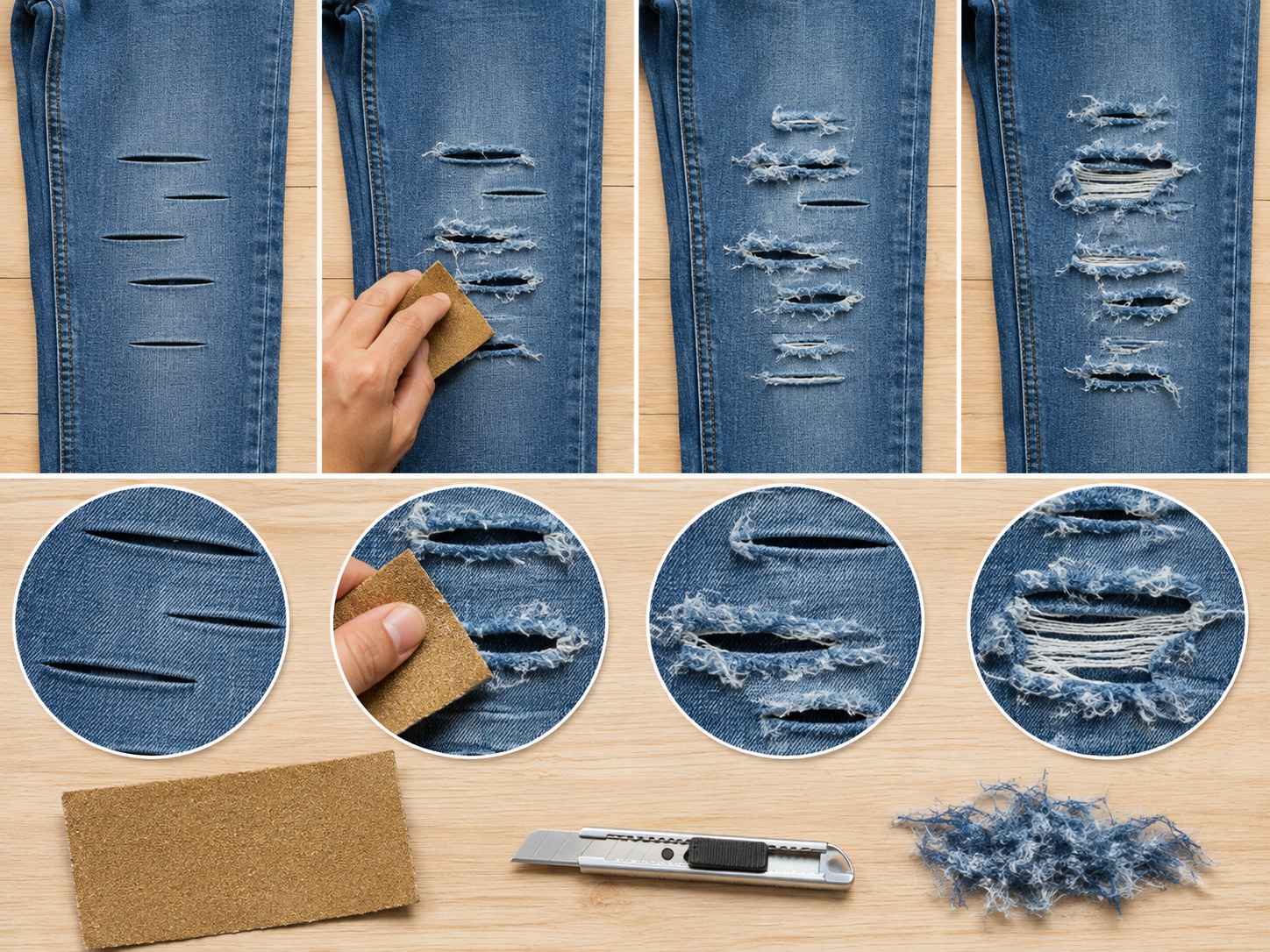
The Final Edge Finishing
I finish expensive raw garments with old rough sandpaper constantly. You add heavy random visual chaos safely. You look at your beautiful pure white thread pile proudly. You make the surrounding blue fabric look heavily damaged too. You buy basic rough sandpaper from a local hardware store cheaply. You rub the top cut border firmly. You rub the bottom cut border roughly. The sandpaper physically destroys the perfect clean fabric edge[^5] nicely. The edge becomes totally soft[^6] safely. You make the final long pants look entirely wild. I give Dean a special smart design secret always. You leave one very thin chalk cut fully alone quietly. You retain the blue threads inside that specific spot carefully. This untouched thin slash adds pure random natural feeling effectively. You create true messy street art physically. You mix big white thread holes with small simple cuts safely. Your boring old solid pants become extreme high fashion nicely. You wear your cool creations extremely proudly.
| Final Finish Step | Main Active Tool | True Design Goal |
|---|---|---|
| Hard rough sanding | Cheap hardware sandpaper | Makes cuts look old naturally |
| Leaving thin uncut slashes | Bare empty human hands | Adds messy random fashion feelings |
| Shaking out loose dust | Plain washing simple machine | Cleans dirty threads perfectly |
Conclusion
You successfully make holes using simple sharp knives and plain tweezers at home safely. You follow natural diamond shapes and pull blue threads gently for perfect results completely.
---

[^1]: "[PDF] Sewing and Clothing Skill A Thon Booklet - Oklahoma 4-H", https://4h.okstate.edu/site-files/events/fcs-skillathon/docs/sewing-and-clothing-book-2025-a.pdf. Textile-care or sewing references support that cutting woven cotton fabric without controlling the cut line and yarn structure can cause fraying, distortion, or unintended enlargement of holes. Evidence role: mechanism; source type: education. Supports: Rough, uncontrolled cutting can damage cotton denim beyond the intended distressed effect.. Scope note: The source would support the risk of uncontrolled fraying, not the subjective judgment that the garment is 'ruined.'
[^2]: "[PDF] Jean Jems - UA Cooperative Extension", https://www.extension.arizona.edu/sites/default/files/pubs/az1445.pdf. General craft and cutting-tool safety materials support that placing a protective backing behind fabric helps isolate the top layer during cutting and reduces damage to layers underneath. Evidence role: general_support; source type: education. Supports: Putting a barrier inside the pant leg helps protect the back layer of fabric while cutting the front.. Scope note: The evidence would support the protective concept, not guarantee complete protection in all cutting conditions.
[^3]: "DIY: how to distress jeans | sew&tell - YouTube", https://www.youtube.com/watch?v=U_mH2OepxkI. A sewing or textile-construction source can support that closely spaced cuts in woven fabric allow yarns between the cuts to be separated and removed, creating a controlled distressed opening. Evidence role: mechanism; source type: education. Supports: Closely spaced horizontal cuts make it easier to separate yarns and form a controlled ripped area.. Scope note: The exact one-centimeter spacing is a practical convention and may not be validated as an optimal distance by formal research.
[^4]: "Symmetrical Traditional Patterns and User Perception: A Study on ...", https://ui.adsabs.harvard.edu/abs/2025Symm...17..960Q/abstract. Studies or design references on material aging and distressing can support that visible regularity and repeated uniform marks are often perceived as manufactured rather than naturally worn. Evidence role: general_support; source type: paper. Supports: Uniform, equal cuts can appear artificial compared with irregular distressing patterns.. Scope note: This supports the design principle of irregularity as naturalistic; perception of style remains subjective.
[^5]: "Quantitative Assessment of Woven Fabric Surface Changes During ...", https://pmc.ncbi.nlm.nih.gov/articles/PMC12348827/. Textile abrasion testing literature supports that abrasive surfaces such as sandpaper damage yarns and fabric surfaces through friction, leading to fuzzing, fraying, and material loss. Evidence role: mechanism; source type: paper. Supports: Rubbing denim with sandpaper abrades the clean cut edge and makes it appear worn.. Scope note: Abrasion-test evidence supports the mechanism but does not prescribe sandpaper use for a particular fashion result.
[^6]: "Elucidation of Softening Mechanism in Rinse Cycle Fabric Softeners. Part 1", https://pmc.ncbi.nlm.nih.gov/articles/PMC4700061/. Textile finishing and abrasion references support that mechanical abrasion can raise fibers, reduce a crisp surface, and create a softer hand or worn feel in cotton fabrics. Evidence role: mechanism; source type: paper. Supports: Abrading cut denim edges can soften or roughen the edge by disrupting surface fibers.. Scope note: Softness depends on denim weight, fiber content, abrasion intensity, and washing; the effect is not guaranteed to be uniform.