Skip to content

leading paragraph:
Your favorite jeans just came out of the dryer, but now they're too small. It's a frustrating waste of money. The culprit is the high heat[^1], and it's the number one enemy of denim.
snippet paragraph:
You should not tumble dry jeans because the high heat and tumbling action cause severe shrinkage, fade the color, and destroy the elastic fibers. This combination permanently damages the denim's fit, texture, and lifespan[^2]. Air drying is the only method that preserves your jeans.
Transition Paragraph:
As someone who has been making jeans for over two decades, I've seen more perfectly good denim get ruined by dryers than by any other cause. It's the most common mistake. People think they are saving time, but they are actually shortening the life of their jeans. Let's break down exactly why the dryer is so destructive and what you should do instead.
Do jeans get ruined in the dryer?
leading paragraph:
You tossed your jeans in the dryer hoping for a quick, soft result. Instead, they came out feeling stiff, tight, and a shade lighter. You're worried you made a permanent mistake.
snippet paragraph:
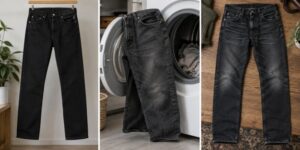
Yes, jeans are ruined in the dryer. The intense heat causes the cotton fibers to shrink permanently and can destroy any spandex, leading to a poor fit. The tumbling friction also strips away the indigo dye, causing them to fade unevenly and look old before their time.
Dive deeper Paragraph:
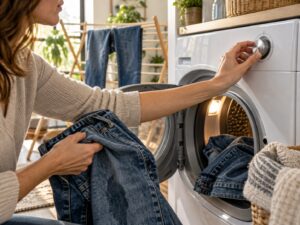
A dryer doesn't just dry your jeans; it actively attacks the fabric in three ways. First is heat-shock shrinkage. Cotton fibers love water. When wet, they swell up. A hot dryer forces that water out violently, causing the fibers to contract far more than they would during gentle air drying. They get shorter, tighter, and stiffer. This isn't a small change; it can make your favorite pair unwearable. Second is color damage. The beautiful indigo color of jeans sits on the surface of the cotton threads[^3]. The combination of high heat and the constant rubbing against the dryer drum acts like sandpaper, scraping off that color unevenly. This doesn't create the cool, natural fades you want. It creates blotchy, worn-out areas. Third, and maybe most important for modern jeans, is elasticity damage. Most jeans today have 1-2% spandex[^4] for comfort and fit. Spandex is a synthetic fiber that can't handle high heat. The dryer literally melts and breaks these fibers, meaning they lose their ability to snap back. Your jeans will become baggy in the knees and seat and will never fit right again.
| Damage Type | Cause | Result |
|---|---|---|
| Shrinkage | High Heat on Cotton | Permanently Tighter and Shorter Fit |
| Fading | Heat + Tumbling Friction | Uneven, Blotchy Color Loss |
| Loss of Stretch | High Heat on Spandex | Baggy Knees and Seat, Poor Shape |
Can I dry jeans in a tumble dryer?
leading paragraph:
You're busy and don't have days to wait for jeans to air dry. A quick spin in the dryer seems like a good compromise. You wonder if using it on a low setting is safe.
snippet paragraph:
You can, but you shouldn't for regular care. The only valid reasons to use a dryer are to intentionally shrink a new pair of "raw" unsanforized jeans, or for a very brief 10-minute cycle on low heat to remove initial dampness before air drying.
Dive deeper Paragraph:
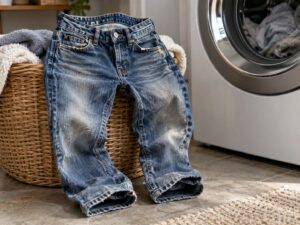
While my standard advice is a firm "no," there are two very specific scenarios where a dryer can be a tool. The first is for denim enthusiasts working with raw, unsanforized jeans[^5]. These jeans are made from fabric that hasn't been pre-shrunk at the factory. The owner buys them larger and intentionally shrinks them for a custom fit. A controlled cycle in a dryer can help maximize this shrinkage. This is an advanced technique and absolutely not for your everyday pair of pre-shrunk jeans.
The second scenario is what I call the "head start" method. If you live in a humid climate or are short on time, you can put your damp jeans in the dryer on a low-heat or air-only cycle for just 10 to 15 minutes. This won't dry them, but it will remove some of the heavy surface moisture and get air circulating through the fabric. Afterward, you must immediately take them out and hang them to finish air drying. The goal is to speed things up without letting the denim get hot enough to cause damage. Even with these exceptions, air drying is always the safest and best method to preserve the fit, feel, and color we work so hard to create.
How can I unshrink my jeans?
leading paragraph:
Your heart sinks as you realize your jeans have shrunk in the wash. You think you've wasted your money on a pair you can no longer wear. Don't throw them out just yet.
snippet paragraph:
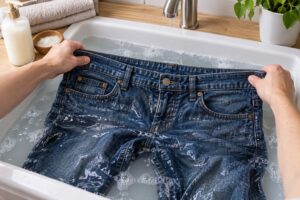
To unshrink jeans, fill a sink with lukewarm water and mix in a tablespoon of hair conditioner. Submerge the jeans for 30 minutes to relax the fibers. Gently squeeze out excess water, then stretch the jeans by hand. Lay them flat to air dry.
Dive deeper Paragraph:
I've talked to many customers who thought their jeans were ruined forever. But you can often bring them back from the brink. The key is to relax the shrunken cotton fibers. Hair conditioner works wonders here; its ingredients soften fabric fibers just like they soften hair.
Here is the step-by-step process:
- Soak: Fill a tub or sink with lukewarm—not hot—water. Stir in a generous amount of cheap hair conditioner. Submerge your jeans completely and let them soak for at least 30 minutes, or up to an hour.
- Rinse & Squeeze: Gently drain the water and rinse the jeans with cool water. Do not wring them out aggressively, as this can stretch them unevenly. Instead, gently squeeze the water out, or roll them up in a dry towel and press on it to absorb moisture.
- Stretch: Lay the damp jeans on the floor. Get on your hands and knees and physically stretch them. Pull on the waistband, the inseam, the outseam, and the thigh area—anywhere they feel tight. You need to be firm but gentle.
- Air Dry: Once you've stretched them, lay them flat or hang them up to air dry away from any direct heat or sun. As they dry, the fibers will set in their new, stretched-out position. This method works best on 100% cotton jeans and can save a pair you thought was lost.
Are jeans safe to put in the dryer?
leading paragraph:
You look at the care tag on your jeans, and it says "Tumble Dry Low." This is confusing after hearing so much advice to the contrary. You don't know who to believe.
snippet paragraph:
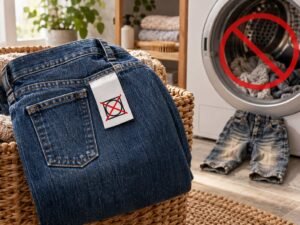
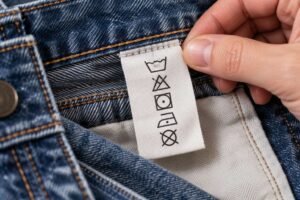
No, jeans are not truly safe in the dryer if you want them to last. The "Tumble Dry Low" label just means the garment won't be immediately destroyed. However, every cycle still causes gradual, cumulative damage to the color, fit, and fabric that air drying avoids.
Dive deeper Paragraph:
This is one of the most confusing things for consumers. As a manufacturer, I can explain the disconnect. Care labels are a legal requirement. The "Tumble Dry Low" symbol indicates the maximum level of heat a garment can withstand without being immediately destroyed. It is a instruction for passing a minimum standard, not a recommendation for optimal care. Just because they can survive a low-heat cycle doesn't mean it's good for them.
Think of it this way: you can run a marathon in dress shoes, but athletic shoes are the better choice. Air drying is the right tool for the job. A designer like Dean spends months perfecting the exact shade of blue and the soft texture of a new wash. We use precise techniques in the factory to achieve this. One cycle in the dryer can strip away that color and make the fabric stiff, undoing all of our careful work. So, my professional advice is to ignore the "Tumble Dry" symbol on the tag. To preserve the jeans as we intended them to be, you must air dry them. It's the only way to protect your investment and keep your jeans looking and feeling great for years.
Conclusion:
A tumble dryer will permanently shrink, fade, and ruin the shape of your jeans. For lasting color and a perfect fit, always wash them in cold water and air dry.
---

[^1]: "Investigation into shrinkage of stretchable denim fabric and its ...", http://ui.adsabs.harvard.edu/abs/2023MURJE..42...41A/abstract. A textile-science source on cotton laundering describes heat as a contributor to dimensional change and fabric damage during drying, supporting the statement that high dryer temperatures are harmful to denim. Evidence role: mechanism; source type: paper. Supports: High dryer heat is especially damaging to denim.. Scope note: The source may address cotton fabrics generally rather than denim jeans specifically, so it supports the mechanism rather than ranking heat as denim’s single greatest enemy.
[^2]: "Optimizing washing conditions for smart fabrics - PMC - NIH", https://pmc.ncbi.nlm.nih.gov/articles/PMC11664346/. Textile-care research links repeated laundering and tumble drying with changes in fabric dimensions, hand feel, color, and mechanical properties, providing contextual support for cumulative damage to jeans over time. Evidence role: general_support; source type: paper. Supports: Dryer use can cumulatively harm the fit, texture, and useful life of denim garments.. Scope note: Such studies usually test fabrics under standardized laundering conditions and may not prove permanent damage for every denim garment.
[^3]: "Indigo Ring Dyeing of Cotton Warp Yarns for Denim Fabric", https://www.academia.edu/120037216/Indigo_Ring_Dyeing_of_Cotton_Warp_Yarns_for_Denim_Fabric. Denim-dyeing references explain that indigo is typically applied as a ring dye that remains concentrated near the surface of cotton yarns, supporting the statement about surface-level color in jeans. Evidence role: definition; source type: education. Supports: Indigo dye in typical denim is concentrated on the surface of cotton yarns.. Scope note: This applies mainly to conventional indigo-dyed denim; other dyeing or garment-finishing methods may differ.
[^4]: "Stretch Denim Material: Spandex, Recovery & QC | LY Denim", https://lydenim.com/denim-stretch-material-everything-you-need-to-know/. Textile sources on stretch denim describe common denim blends that include small percentages of elastane or spandex to improve comfort and fit, providing contextual support for the stated 1–2% range. Evidence role: general_support; source type: paper. Supports: Modern stretch jeans often contain a small percentage of spandex or elastane.. Scope note: A source may confirm that low elastane percentages are common in stretch denim but may not establish that most jeans on the market contain exactly 1–2% spandex.
[^5]: "How to Shrink a Cotton Shirt Properly to Change Its Size ...", https://staging.southernwv.edu/how-to-shrink-a-cotton-shirt/. Historical and textile references on sanforization define it as a controlled pre-shrinking process for cotton fabrics, supporting the distinction between raw unsanforized denim and pre-shrunk denim. Evidence role: historical_context; source type: encyclopedia. Supports: Unsanforized denim has not undergone the sanforization pre-shrinking process.. Scope note: Definitions of “raw” and “unsanforized” can vary in consumer use; the source should specifically address sanforization as pre-shrinking.